|
Home SEA PEOPLES AND THE PHOENICIANS: A CRITICAL TURNING POINT IN HISTORY |
|
Based on the paper presented by Sanford Holst at Al Akhawayn University in Ifrane, Morocco on June 28, 2005
Relentless attacks by groups known as the Sea Peoples
around 1200 BC virtually destroyed all the major powers of the
Mediterranean, and cleared the way for the rise of the Greeks, Romans
and Western civilization.[i]
Surprisingly for such a pivotal moment in world history, the events
which took place at that time are not well understood and are widely
debated. Many theories have been advanced to explain these times, and
their participants have been declared to come from Anatolia, or the
Aegean, or even Atlantis. We will consider the various theories, as well
as a new composite view which does not appear to have been considered
previously.
An important element mentioned by many sources, and yet
given consideration by virtually none, is the simple fact that—in the
midst of a cataclysm which destroyed almost every city in the eastern
Mediterranean area—the Phoenician cities remained untouched. This turns
out to be one of the keys which help to unlock the mystery of the Sea
Peoples—an event which changed the course of history. Theories Advanced
The traditional major milestone events in the Sea Peoples
invasion are:[ii]
·
1208 BC
- King Merneptah of Egypt turned back an incursion by
the Sea Peoples and Libyans at the Nile Delta.
·
1180 BC
- The Hittite empire fell.
·
1180 to 1176 BC - The
Levant fell (eastern seaboard of the Mediterranean) except for the
Phoenician cities.
·
1176 BC
- King Ramses III of Egypt stopped the Sea Peoples
attacks by land and by sea, allowing them to keep the land they had
taken.
The main current theory advanced to explain the origin
and actions of the Sea Peoples has been described by Eliezer D. Oren[iii]
as “the collapse of the two great empires of that day—the Hittite in
Anatolia and the Mycenaean in Greece—brought about their (peoples’) mass
migrations to the coastlands of the Levant and Cyprus.” The collapse of
those two empires was basically laid to economic and environmental
factors.
Shelley Wachsmann[iv]
added a significant point which was missing from the above explanation,
and that was the participation of people from Central Europe and the
Black Sea region. This may have been a major factor in the events of
this time.
Another theory which was previously prominent held that
the Sea Peoples were almost entirely from western Anatolia. This view
was championed by R. D. Barnett[v]
and by others such as Eberhard Zangger[vi].
However recent scholarship has shown rather clearly that these peoples
came from a wider area, indicating a wider range of causes for these
events.
An examination of the Sea Peoples would be remiss if it
did not also acknowledge another popular theory: that these people were
from the lost city of Atlantis, as identified by Frank Joseph[vii]
and others. It must be admitted that this theory had a promising
historical genesis: a description by Plato, unknown peoples, and
inscriptions on Egyptian temples. Now, however, some of those people
listed by the Egyptians, such as the Lukka, have been identified and
their homes in Anatolia are known. Also, Plato identified Atlantis as
having perished long before the Sea Peoples. Until Joseph excavates his
proposed site or someone else can show this legendary place still
existed—and then perished—at the same time as the Sea Peoples (sending
them out to conquer other lands), this possibility is not adequately
supported.
In addition to considering the other theories mentioned
above, a composite view is also considered—which brings together
well-supported elements from the other theories. This approach may allow
greater conformance with the array of facts discovered about the Sea
Peoples and the events of this time. Facts Presented
As previously mentioned, some theories comment upon but
do not look into the curious fact that Phoenician cities seem to have
been unaffected by the destruction which went on around them at this
time. First, let us consider the documented history of these cities, and
note whether any destruction occurred to them during the time being
studied.
Tyre was one of the leading Phoenician cities in 1200 BC,
and we are fortunate to have an excellent archaeological study of this
site which went all the way down to bedrock. Performed by Patricia Bikai
in 1973, this work documented clearly the relevant layers of interest to
us.[viii]
They not only showed there was no widespread destruction at that time,
there was also great continuity from layer to layer, indicating that the
local society continued to live in the same way throughout this period.
The results were highly conclusive.
Sarepta (modern Sarafand) between Tyre and Sidon was
similarly the subject of detailed archaeological study. Glenn Markoe
described the results as showing no destruction and having great
continuity in the strata.[ix]
This likewise was quite conclusive.
Sidon and Byblos were the other significant Phoenician
cities at this time, but to date insufficient research has been
conducted to support or deny the conclusion of no destruction at these
sites.[x]
It is hoped that additional archaeological work will eventually be
performed to verify their status as well.
The most northern Phoenician city was on the island of
Arwad, also known as Arvad and Arados. It had been taken from the
Phoenicians prior to the coming of the Sea Peoples and was being held by
the Hittites. This city was in fact destroyed by the Sea Peoples[xi]—and
after their incursion it was returned to the Phoenicians.[xii]
Rather than disproving the current assertion, this remarkable treatment
of Arwad adds to the view that the Phoenicians were accorded a special
status by the invading peoples.
Based upon the sum of this evidence, we can only conclude that
observations of the Phoenician cites being undamaged during this time,
and having been accorded a special status by the invaders, have been
verified. That there was a relationship or partnership of some nature
between the Sea Peoples and the Phoenicians is clearly in evidence.
The next step in probing the mystery of the Sea Peoples
is to examine the economic and environmental factors cited by Philip C.
Betancourt[xiii]
and others as being the primary cause of the mass migration of the Sea
Peoples. In this interesting train of logic, Betancourt et al seem to
have begun by observing that after the Sea Peoples were settled
in Palestine there was a similarity between their pottery and that of
the Mycenaeans. Therefore the assumption was made that the Sea Peoples
were Mycenaeans. This led to a search being made in Greece to find the
cause of the Sea Peoples migration. Betancourt noted there was an
adequate supply of food at this time in Greece and that the population
had grown very large. An essential link in their food system was the
extensive trade in the Aegean which allowed shortages in any locality to
be made up by shipments from other areas.
He also pointed out that widespread disruption of this
system of distribution could have caused a collapse of the society and a
descent into warfare and migration. He postulated further that a simple
two-year drought could have caused this whole system to collapse. All of
this was offered to support a position that the Mycenaeans might have
been the Sea Peoples.
But at that point the model failed. He admitted that the
similarity between Mycenaean and Philistine pottery did not begin until
a later date—the middle of the 12th century BC—and not at the
beginning of that century when the Sea Peoples migration took place.
Further there was no evidence of widespread drought or famine in Greece
prior to the Sea Peoples attacks. Similarly there was no evidence of the
Mycenaeans destroying the Hittite empire, nor of their forming vast
caravans of people moving by land down the Levantine coast. Yet the
actual Sea Peoples did all these things. We will soon see how the
Mycenaeans fit into the events of this time—however it is already clear
they were not the Sea Peoples.
Trevor Bryce[xiv]
and others who examined conditions in Anatolia at this time found a
completely different picture than the one shown in Mycenaean Greece.
Food shortages definitely existed in Anatolia, which the Hittites were
able to relieve by importing wheat and other goods from Egypt and
Canaan. However the peoples of western and northern Anatolia were not
members of the Hittite world, and in fact were frequently at war with
that empire and with the Mycenaeans. In this part of Anatolia is where
we find unrelieved food shortages and increasing pressure to take some
form of necessary action.
To illustrate the problem clearly, Itamar Singer[xv]
cited texts from the Emar region which state there was a year of
hardship in which three qa of grain cost one silver shekel. Then
later a shekel would buy only two qa of grain. Finally that same
amount of silver would buy only one qa of grain. The price of
grain had already become a hardship—and then it had tripled in cost.
There clearly was a rising food shortage at this time.
Having said this, it must be noted that other motivations
appear to have existed for the Sea Peoples as well. As pointed out by
Wachsmann,[xvi]
some groups among them may have joined simply due to greed. The
quick-strike raids in the Aegean and across the southern coast of
Anatolia seem particularly of this nature, given that delivering
settlers into those areas does not seem to have been the prime
motivation.
A
symbiotic relationship seems to have developed between those who were
motivated to find good land for their families and those who simply
wanted booty and adventure. The chaos created by each benefited the
other, and the results suggest they came to share mutual enemies and
mutual allies.
We have seen how pressures were increasing in and around
Anatolia. But why was this particular moment chosen for exploding into
action? Before answering that question, let us examine the intense
pressures which were mounting upon the Phoenicians. Campaigns Triggered
The Phoenician people had been dominant sea traders in
the Mediterranean prior to 1500 BC[xvii],[xviii]
and in some cases had partnered with others to maintain that position.
Then the rise of the Mycenaeans[xix]
caused sea trade in the Aegean—and even as far as Cyprus—to fall into
the hands of that new power. This pushed the Phoenicians backward from
the west.
The growth of Ugarit as a major sea trader[xx]
located just north of the Phoenicians exerted additional pressure from
that direction. Immediately beside that powerful city were the Hittites,
whose increasing territorial expansion across lands to the north and
east of the Phoenicians brought that dangerous land-force closer.
Also after 1500 BC the Egyptian pharaohs sent their
armies up the Levantine coast and demanded to be recognized as overlords
of the Phoenicians[xxi]
as well as the rest of the Levant. Although the Phoenician people
retained a great deal of independence under this arrangement, they were
subjected to heavy demands for tribute which was theoretically buying
Egyptian protection. As the Amarna letters showed, however, that
protection was somewhere between weak and non-existent, with raiders
coming into Phoenician lands unimpeded.[xxii]
During this time the Hittites continued to press
southward. They engulfed Ugarit and came to the borders of Phoenicia.
The powerful Ramses II of Egypt fought the Hittites, but finally signed
a treaty with them in 1258 BC which ceded to the Hittites all the lands
those people had taken.[xxiii]
To the Phoenicians it must have been evident the next push southward by
the Hittites would breach the walls of their coastal cities, at which
point the sea traders could again expect no support from Egypt, and
Phoenicia would in all probability cease to exist.
As a brief digression from the sea traders’ problems, we
note that during the next forty-five years of Ramses’ long reign
following this treaty, the Hittites were beset on all sides but held
their own. They fought the Assyrians in the east, the fierce Kaska
people who controlled the north shore of Anatolia, and they fought the
several groups of people who divided western Anatolia among them.[xxiv]
Meanwhile the Mycenaeans continued to raid into western Anatolia and
held lands in the neighborhood of Miletus, which was also known as
Millawanda.[xxv]
Then, in 1213 BC, the great Ramses II died[xxvi]
and a paroxysm seized the entire region. It was fairly common in the
ancient Mediterranean for the death of a powerful king to lead to
attacks by neighboring states, each seeking to determine if the
successor king was weak, and if prized lands might be wrested away. The
Phoenicians would have had every reason to fear an imminent campaign
southward by the Hittites. However the Hittites were preoccupied by
problems at home and put off action in this direction.
Instead it was the Sea Peoples who took action. In 1208
BC they sailed to Egypt in small numbers, estimated at 5000 warriors,[xxvii]
and attacked the successor to Ramses: king Merneptah. To do this they
joined with the Egyptians’ western neighbors, the Libyans, and mounted
an attack on the Nile Delta. Merneptah routed those forces, as described
on his victory stele at Thebes.[xxviii]
This attack by the Sea Peoples on Egypt, the breadbasket
which had been supplying the Hittites with wheat via Ugarit,[xxix]
was consistent with the argument that these people were driven by food
shortages in their lands. The Sea Peoples’ first strike, if successful,
would have acquired ownership of some part of that food source. Even
though the Hittites were the long-time adversaries of virtually all the
people who made up the Sea Peoples, the Hittites had no excess of food,
so the first strike had gone against Egypt.
On this same subject, one might well ask what led to the
special treatment the Phoenicians seem to have been given by the Sea
People. What services could the Sea Peoples possibly have received from
these maritime traders? As was noted, widespread food shortages in the
north had driven up the price of wheat to incredible levels. Widely
known as astute merchants,[xxx]
the Phoenicians would naturally have included wheat shipments in their
sea trade at this time. Since Ugarit held a virtual monopoly on wheat
shipments to the Hittites,[xxxi]
that market was not open to the Phoenicians. Instead these sea traders
had to push far afield to western Anatolia, the Aegean and the Black
Sea—the areas which gave rise to the Sea Peoples. At a time of severe
food shortages, when this need was about to erupt into a truly massive
migration of people, the Phoenicians were the ones who could bring some
quantity of food.
With the Hittites threatening their northern border, the
Phoenicians would reasonably have supported whichever groups among Sea
Peoples wanted to shift attacks away from the failed effort at Egypt and
toward a more promising one against the Hittites. With hindsight we can
now see what attraction this course of action would have held for the
Sea Peoples. Though the Hittites themselves had no excess food to offer,
they stood between the Sea Peoples and an achievable goal: the land of
Canaan surrounding the Phoenicians, which was second only to Egypt as a
source of wheat.[xxxii]
In addition, by going through the Hittite land and Canaan, the Sea
Peoples would bring a force numbering hundreds of thousands to confront
the wheat-rich Egyptians—rather than the handful of warriors who had
failed on the first attempt.[xxxiii]
The attacks against the Hittites began by land. In fact
the greatest campaigns the Sea Peoples would mount were by land. This
has led recent sources to refer to them as the Land and Sea Peoples[xxxiv]
which is a much more accurate appellation. The Kaska lived to the north
of the Hittites, between them and the Black Sea, and attacked at this
time. The Assuwa, Arzawa and Lukka lived in the land to the west of the
Hittites, between that empire and the Aegean Sea, and also attacked. But
a problem had to be overcome. The Mycenaeans continued to hold the
Aegean and attacked the Anatolian people from the seaward side.[xxxv]
To deal with this, warriors and ships in the Sea Peoples confederacy
poured from Anatolia and the Black Sea into the Aegean, where they
ravaged the Mycenaeans in their islands and on the Greek mainland. The
Mycenaean citadel-cities may or may not have been taken at this time,
but the coastal towns were certainly laid waste by these raiders.
Betancourt’s model has therefore proven partially correct—because
following this widespread disruption the Mycenaean cities withered and
eventually died.[xxxvi]
When the Aegean had been thus cleared, the people of western Anatolia
were no longer fighting on two fronts. They were able to turn their full
attention to the Hittites. The now-open Aegean allowed ships belonging
to the Sea Peoples to sail through those waters and begin to raid the
Hittites all along their Mediterranean coast.[xxxvii]
This proved to be pivotal in the struggle against that entrenched power.
In 1182 BC Ugarit fell and the flow of wheat from Egypt was cut off.[xxxviii]
Approximately two years later the Kaska captured Hattusas, the capital
of the Hittites, and that empire died.[xxxix]
The Hittite blockage had been removed. Now nothing stood
in the way of the Sea Peoples’ exodus. With their wives, children and
household possessions in two-wheeled carts, the Sea Peoples—now more
properly the Land Peoples—flowed across the former Hittite territory. At
the territory’s southeast corner they turned south on their path of
destruction and, observing their special relationship with Phoenicia,
they by-passed that land. Flowing down through Canaan they destroyed the
cities they encountered.[xl]
Many settled beside the wheat fields and took some of the land for
themselves and their families.
A very large number of the Land and Sea Peoples continued
onward and eventually arrived at the border between Canaan and Egypt.
There they were met by the armies of Ramses III and a great battle was
fought—with a second battle being fought in the Nile Delta—according to
descriptions on his funerary temple at Medinet Habu in Thebes.[xli]
The [Northerners] in their isles were disturbed, taken
away in the [fray] at one time. Not one stood before their hands, from
Kheta (Hittite empire), Kode (Cilicia), Carchemish, Arvad, Alasa
(Cyprus), they were wasted. {The}y {[set up]} a camp in one place in
Amor (near Ugarit). They desolated his people and his land like that
which is not. They came with fire prepared before them, forward to
Egypt. Their main support was Peleset, Thekel (Tjeker), Shekelesh,
Denyen, and Weshesh. (These) lands were united, and they laid their
hands upon the land as far as the Circle of the Earth. Their hearts were
confident, full of their plans.
Now, it happened through this god, the lord of gods, that
I was prepared and armed to [trap] them like wild fowl. He furnished my
strength and caused my plans to prosper. I went forth, directing these
marvelous things. I equipped my frontier in Zahi, prepared before them.
The chiefs, the captains of infantry, the nobles, I caused to equip the
harbor-mouths, like a strong wall, with warships, galleys, and barges.
They were manned [completely] from bow to stern with valiant warriors
bearing their arms, soldiers of all the choicest of Egypt, being like
lions roaring upon the mountain-tops. The charioteers were warriors, and
all good officers, ready of hand. Their horses were quivering in their
every limb, ready to crush the countries under their feet. I was the
valiant Montu, stationed before them, that they might behold the
hand-to-hand fighting of my arms. I, king Ramses III, was made a
far-striding hero, conscious of his might, valiant to lead his army in
the day of battle.
Those who reached my boundary, their seed is not; their
heart and their soul are finished forever and ever. As for those who had
assembled before them on the sea, the full flame was in their front,
before the harbor-mouths, and a wall of metal upon the shore surrounded
them. They were dragged, overturned, and laid low upon the beach; slain
and made heaps from stern to bow of their galleys, while all their
things were cast upon the water.
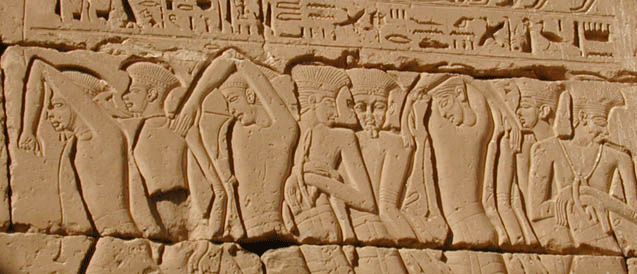
This description at Medinet Habu was accompanied by
pictures displaying battle scenes in which the Sea Peoples’ boats were
shown as having a very peculiar design: The fore-post and aft-post were
identical and each had a bird’s head at the top. Wachsmann traced this
design to vessels found only in Central Europe[xlii]
along the Danube River corridor. The Danube River emptied into the Black
Sea on the north side of Anatolia, where boatmen from this region could
join the rest of the Sea Peoples. It should be noted that the names of
several groups among the Sea Peoples were not found anywhere in the
Anatolian or Aegean regions, and might reasonably have designated people
who came from the Black Sea area. Also, as noted earlier, refugees from
the shattered Mycenaean world would eventually come to live among the
Sea Peoples, though they did not begin to arrive in Cyprus and Palestine
until the latter part of the 12th century BC.[xliii]
Experts differ over exactly how many battles were fought
between Ramses and the Sea Peoples, as well as where they were fought.
But the net result was that the Sea Peoples were finally stopped in
their southward movement. Large numbers of them settled in Canaan and
gave their own name to the land: primarily the Peleset people who
settled a wide swath of land which became known as Palestine.[xliv]
Others sailed west and settled upon islands which were likewise given
the name of the tribe which settled there: the Shekelesh who settled on
Sicily,[xlv]
the Sherden who settled on Sardinia,[xlvi]
and several settlements in other lands. Sea Peoples Identified
Who were the Sea Peoples? This issue has been touched
upon briefly several times during this analysis, and it deserves to be
addressed directly. Perhaps the best and most unambiguous way to answer
this question is to separate the winners from the losers in this epic
series of battles. As we have seen, the major losers were a) the city of
Ugarit which was totally destroyed and never rebuilt, b) the Hittite
empire which was destroyed and left only a residual fragment on the
Euphrates River, c) the Mycenaeans who were fatally wounded and would
disappear completely within a hundred years, and d) Egypt which had won
the battles but lost the Levant—it would waste away and become a shadow
of its former self.
The winners, who constituted the Sea Peoples’
confederacy, were a) the tribes of people who came from Anatolia—and the
lands to its north and west—who migrated into the Levant and onto
islands across the Mediterranean, b) the Kaska who kept their original
lands in the north of Anatolia on the Black Sea, and added the heart of
the Hittite territories to their own, c) the West Anatolian people who
remained in their own lands, but added some of the Hittite lands, and
gained influence in the Aegean, and d) the Phoenicians who seem to have
gained more than anyone else from the mass migration of the Land and Sea
Peoples. Aftermath
Under the destructive force of the Sea Peoples’ attacks,
all of the Phoenicians’ powerful adversaries had been destroyed. The
Phoenician cities were untouched by this devastation that happened
around them, which left these people in an advantageous position.
The historical record[xlvii],[xlviii]
shows their active cities quickly began to expand their domain by
placing trading posts in Cyprus, the Aegean, Sicily, Sardinia, North
Africa, Algeria, Morocco and Spain.
Among the cities they created were these in Morocco:
Lixis (modern Larache), Sala (Rabat), Mogador (Essaouira) and Tingis
(Tangier); in Spain: Gadir (Cadiz), Malaka (Malaga), Ibisa (Ibiza); in
Algeria: Icosia (Algiers); in Tunisia: Utica and Carthage, both now
gone; in Sardinia: Karalis (Cagliari); in Sicily: Panormus (Palermo); in
Cyprus: Kition (Larnaca). These were in addition to their home cities
in Lebanon: Tyre (Sor), Sidon (Saida), Beirut (Beirut), Byblos (Jbail),
Tripoli (Trablous), and many others. The Phoenicians gave rise to a
powerful and wealthy sea-trading empire which stretched from Morocco to
the Levant.
As a result of assembling and examining these many
scattered facts about the Sea Peoples, which had been documented in
separate studies by noted scholars, a larger picture has emerged. We are
better able to see who the Sea Peoples were, what drove them, the
actions they took, and where they settled. By clarifying the “mysteries”
surrounding them, we are now able to more fully understand this critical
turning point in history. The legacy of the Sea Peoples was that they had forcefully cleared away the old powers from the Mediterranean and left freshly plowed ground. In time the Greeks and Romans would rise and they—together with the often overlooked Phoenicians—would sow the seeds of Western civilization. _______________ Notes
[i]
Grant, Michael The Ancient Mediterranean (New York:
Meridian, 1988), p. 80. [ii] Experts cannot agree on the specific year in which each of these events occurred. In each case there is a cluster of dates within a narrow band for these events. One of the well-supported dates within each band has been identified for use in this paper. Using any of the other dates within these bands does not change the outcome.
[iii]
Oren, Eliezer D. “Introduction” The Sea Peoples and Their
World: A Reassessment (Philadelphia: University of
Pennsylvania Museum, 2000), p. xvii.
[iv]
Wachsmann, Shelley “To the Sea of the Philistines” The Sea
Peoples and Their World: A Reassessment (Philadelphia:
University of Pennsylvania Museum, 2000), p. 122.
[v]
Barnett, R. D. “The Sea Peoples” Cambridge Ancient History
(Cambridge: Cambridge University Press, 1975), Vol. II, Part 2,
pp.359-378.
[vi]
Zangger, Eberhard “Who Were the Sea People?” Saudi Aramco
World 46:3 (Houston, 1995), pp. 20-31.
[vii]
Joseph, Frank Survivors of Atlantis (Rochester, VT:
Bear & Co, 2004), pp. 10-23.
[viii]
Bikai, Patricia The Pottery of Tyre (Warminster, UK:
Aris & Phillips, 1978), pp. 73-74.
[ix]
Markoe, Glenn Peoples of the Past: Phoenicians
(Berkeley: University of California Press, 2000), p. 24.
[x]
Markoe, Peoples of the Past: Phoenicians, p. 24.
[xi]
Breasted, J. H. Ancient Records of Egypt (Chicago:
University of Illinois Press, 2001/1906), vol. 4, pp. 37-39.
[xii]
Moscati, Sabatino The World of the Phoenicians (Italian,
translated into English by Weidenfeld and Nicolson)
(London: Orion Books, 1999/1968), pp. 9.
[xiii]
Betancourt, Philip P. “The Aegean and the Origin of the Sea
Peoples” The Sea Peoples and Their World: A Reassessment
(Philadelphia: University of Pennsylvania Museum, 2000), pp.
298-300.
[xiv]
Bryce, Trevor The Kingdom of the Hittites (Oxford:
Clerendon Press, 1998), pp. 364-365.
[xv]
Singer, Itamar “New Evidence on the End of the Hittite Empire”
The Sea Peoples and Their World: A Reassessment
(Philadelphia: University of Pennsylvania Museum, 2000), pp.
24-25.
[xvi]
Wachsmann, “To the Sea of the Philistines”, pp. 103-105.
[xvii]
Holst, Sanford “Origin of the Phoenician Trading Empire”
World History Association conference paper presented in
Fairfax, Virginia, 2004, pp. 1-8.
[xviii]
Bentley, Jerry and Herbert Ziegler Traditions & Encounters
(New York: McGraw Hill, 2000), p.51.
[xix]
McDonald, William A. and Carol G. Thomas Progress into the
Past: The Rediscovery of Mycenaean Civilization
(Indianapolis: Indiana University Press, 1990), p. 420.
[xx]
Grant, The Ancient Mediterranean, p. 76.
[xxi]
Grimal, Nicolas A History of Ancient Egypt (French,
translated into English by Ian Shaw) (Oxford: Blackwell,
1988), p. 215.
[xxii]
Dunand, Maurice Byblos (French, translated into English by
H. Tabet) (Paris: Librairie Adrien-Maisonneuve, 1973), pp.
28-29.
[xxiii]
Bryce, The Kingdom of the Hittites, p. 306.
[xxiv]
Bryce, The Kingdom of the Hittites, p. 320.
[xxv]
Bryce, The Kingdom of the Hittites, p. 60.
[xxvi]
Freeman, Charles Egypt, Grece and Rome (New York:
Oxford University Press, 2004), p.74.
[xxvii]
Wood, Michael In Search of the Trojan War (Berkeley:
University of California Press, 1998), p. 219.
[xxviii]
Barnett, “The Sea Peoples”, p. 366.
[xxix]
Bryce, The Kingdom of the Hittites, p. 364. [xxx] Grant, The Ancient Mediterranean, pp. 60-61.
[xxxi]
Bryce, The Kingdom of the Hittites, p. 356.
[xxxii]
Bryce, The Kingdom of the Hittites, p. 357.
[xxxiii]
Sandars, Nancy K. The Sea Peoples (London: Thames and
Hudson, 1978), p. 133.
[xxxiv]
McDonald and Thomas, Progress into the Past: The Rediscovery
of Mycenaean Civilization, p. 459.
[xxxv]
Bryce, The Kingdom of the Hittites, p. 399.
[xxxvi]
Sandars, The Sea Peoples, p. 197.
[xxxvii]
Bryce, The Kingdom of the Hittites, pp. 366-367.
[xxxviii]
Van Soldt, W.H. “Ugarit: A Second-Millennium Kingdom on the
Mediterranean Coast” Civilizations of the Ancient Near East
(New York: Charles Scribner’s Sons, 1995), p. 1265.
[xxxix]
Murnane, William J. “The History of Ancient Egypt: An
Overview” Civilizations of the Ancient Near East (New
York: Charles Scribner’s Sons, 1995), p. 708.
[xl]
Finkelstein, Israel “The Philistine Settlements: When, Where
and How Many?” The Sea Peoples and Their World: A
Reassessment (Philadelphia: University of Pennsylvania
Museum, 2000), p. 159.
[xli]
Breasted, Ancient Records of Egypt, vol. 4, pp. 37-39.
[xlii]
Wachsmann, “To the Sea of the Philistines”, p.122.
[xliii]
Sandars, The Sea Peoples, p. 183.
[xliv]
Dothan, Trude “The ‘Sea Peoples’ and the Philistines of Ancient
Palestine” Civilizations of the Ancient Near East (New
York: Charles Scribner’s Sons, 1995), pp. 1267-1279.
[xlv]
Barnett, “The Sea Peoples”, pp. 367-368.
[xlvi]
Sandars, The Sea Peoples, p. 161.
[xlvii]
Markoe, Peoples of the Past: Phoenicians, pp. 170-188.
[xlviii]
Moscati, Sabatino The Phoenicians (New York: Rizzoli
International, 1999/1988), pp. 8-304.
|