|
Home NECHO II |
|
by Wikipedia (All Bible "PROOF" edited out.)
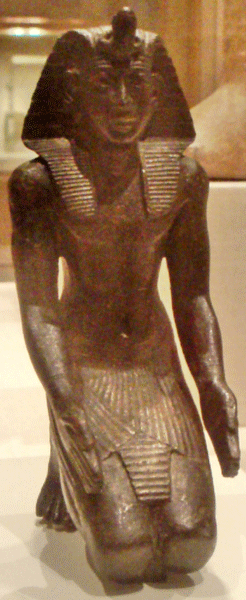
A small kneeling bronze statuette, likely Necho II, now residing in the Brooklyn Museum Necho II (sometimes Nekau) was a king of the Twenty-sixth dynasty of Egypt (610 BCE - 595 BCE). Biography Family Necho II was the son of Psammetichus I by his Great Royal Wife Mehtenweskhet. His prenomen or royal name Wahemibre means "Carrying out the Wish of Re."[2] Military campaign Herodotus reports the campaign of the pharaoh in his Histories:
Ambitious projects Necho II initiated but never completed the ambitious project of cutting a navigable canal from the Pelusiac branch of the Nile to the Red Sea, the earliest precursor of the Suez Canal.[3] It was in connection with this new activity that Necho founded the new entrepot city of Per-Temu Tjeku which translates as 'The House of Atum of Tjeku' at the site now known as Tell el-Maskhuta[4], about 15 km west of Ismailia. The waterway was intended to facilitate trade between the Mediterranean Sea and the Indian Ocean; Necho also formed an Egyptian navy by recruiting displaced Ionian Greeks. This was an unprecedented act by the pharaoh since most Egyptians had traditionally harboured an inherent distaste for and fear of the sea.[5] The navy which Necho created served to operate along both the Mediterranean and Red Sea coasts.[6] Herodotus (4.42) also reports that Necho sent out an expedition of Phoenicians, who in three years sailed from the Red Sea around Africa back to the mouth of the Nile.[7] Some current historians tend to believe Herodotus' account, primarily because he stated with disbelief that the Phoenicians as they sailed on a westerly course round the southern end of Libya (Africa), they had the sun on their right -- to northward of them" (The Histories 4.42) -- in Herodotus' time it was not known that Africa extended south past the equator. However, Egyptologists also point out that it would have been extremely unusual for an Egyptian Pharaoh to carry out such an expedition.[8] Alan B. Lloyd doubts the event and attributes the development of the story by other events.[9] Death and succession
Necho II died in 595 BC and was
succeeded by his son, Psamtik II, as the next pharaoh of Egypt. Psamtik
II, however, later removed Necho's name from almost all of his father's
monuments for unknown reasons.
Peter Clayton (1994). Chronicle of
the Pharaohs, Thames and Hudson. References General information
Budge, E. A. W. (1894). The mummy:
Chapters on Egyptian funereal archaeology. Cambridge [England]:
University Press. page 56+. _______________ Notes: 2. Peter Clayton, Chronicle of the Pharaohs, Thames and Hudson, 1994. p.195 3. Redmount, Carol A. "The Wadi Tumilat and the "Canal of the Pharaohs"" Journal of Near Eastern Studies, Vol. 54, No. 2 (Apr., 1995), pp. 127-135 4. Shaw & Nicholson, p.201 5. Clayton, p.196 6. Herodotus 2.158; Pliny N.H. 6.165ff; Diodorus Siculus 3.43 7. Note however that though the original documents state "Red Sea", many ancient manuscripts reference the "Mediterranean Sea" as the "Red Sea". See History of Suez Canal and painting by Wybylack for more detail. 8. For instance, the Egyptologist Alan Lloyd wrote "Given the context of Egyptian thought, economic life, and military interests, it is impossible for one to imagine what stimulus could have motivated Necho in such a scheme and if we cannot provide a reason which is sound within Egyptian terms of reference, then we have good reason to doubt the historicity of the entire episode." Alan B. Lloyd, "Necho and the Red Sea: Some Considerations", Journal of Egyptian Archaeology, 63 (1977) p.149. 9. Lloyd points out that geographical knowledge at the time of Herodutus was such that Greeks would know that such a voyage would entail the sun being on their right but did not believe Africa could extend far enough for this to happen. He suggests that the Greeks at this time understood that anyone going south far enough and then turning west would have the sun on their right but found it unbelievable that Africa reached so far south. He suggests that "It is extremely unlikely that an Egyptian king would, or could, have acted as Necho is depicted as doing" and that the story might have been triggered by the failure of Sataspes attempt to circumnavigate Africa under Xerxes the Great. For more see: Lloyd, Alan B. "Necho and the Red Sea: Some Considerations Journal of Egyptian Archaeology, Vol. 63, (1977), pp. 142-155
|