|
by Wikipedia
The Bible refers to one of two
closely related religious texts central to Judaism and Christianity—the
Hebrew or Christian sacred scriptures respectively.
It is not a
history book in the modern sense.
Judaism recognizes
a single set of canonical books known as the Tanakh, also called Hebrew
Bible, traditionally divided into three parts: the Torah ("teaching" or
"law"), the Nevi'im ("prophets"), and the Ketuvim ("writings").
The Bible as used
by Christians is divided into the Old Testament and the New Testament.
The canonical composition of the Old Testament is in dispute between
Christian groups: Protestants hold the books of the Hebrew Bible to be
canonical and include them in what they call the Old Testament. Roman
Catholics and Eastern Orthodox additionally consider the
deuterocanonical books, a group of Jewish books, to be a canonical part
of their Old Testament. The New Testament is comprised of the Gospels
("good news"), the Acts of the Apostles, the Epistles (letters), and the
Book of Revelation.
The term "bible"
is sometimes used to refer to any central text of a religion, or a
comprehensive guidebook on a particular subject.
Etymology
According to the
Online Etymology Dictionary, the word bible[2] is from the Latin
biblia, traced from the same word through Medieval Latin and Late
Latin, as used in the phrase biblia sacra ("holy book"—"In the Latin of
the Middle Ages, the neuter plural for Biblia (gen. bibliorum) gradually
came to be regarded as a feminine singular noun (biblia, gen. bibliae in
which singular form the word has passed into the languages of the
Western world.")[3] This stemmed from the Greek term τὰ βιβλία τὰ
ἅγια (ta biblia ta hagia), "the holy books", which derived from βιβλίον
(biblion),[4] "paper" or "scroll," the ordinary word for "book", which
was originally a diminutive of βύβλος (byblos, "Egyptian papyrus"),
possibly so called from the name of the Phoenician port Byblos (also
known as Gebal) from whence Egyptian papyrus was exported to Greece.
The Greek phrase
Ta biblia (lit. "little papyrus books")[5] was "an expression
Hellenistic Jews used to describe their sacred books several centuries
before the time of Jesus,"[6] and would have referred to the
Septuagint.[7] The Online Etymology Dictionary states, "The Christian
scripture was referred to in Greek as Ta Biblia as early as c.223."[2]
Jewish canon
Tanakh
The Tanakh
(Hebrew: תנ"ך) consists of 24 books. Tanakh is an acronym for the three
parts of the Hebrew Bible: the Torah ("Teaching/Law" also known as the
Pentateuch), Nevi'im ("Prophets"), and Ketuvim ("Writings," or
Hagiographa), and is used commonly by Jews but unfamiliar to many
English speakers and others (Alexander 1999, p. 17). (See Table of books
of Judeo-Christian Scripture.)
Torah
The Torah, or
"Instruction," is also known as the "Five Books" of Moses, thus Chumash
from Hebrew meaning "fivesome," and Pentateuch from Greek meaning "five
scroll-cases."
The Torah
comprises the following five books:
1. Genesis, Ge—Bereshit
(בראשית)
2. Exodus, Ex—Shemot (שמו)
3. Leviticus, Le—Vayikra (ויקרא)
4. Numbers, Nu—Bamidbar (במדבר)
5. Deuteronomy, Dt—Devarim (דברים)
The Hebrew book
titles come from some of the first words in the respective texts.
The Torah focuses
on three moments in the changing relationship between God and people.
The first eleven chapters of Genesis provide accounts of the creation
(or ordering) of the world, and the history of God's early relationship
with humanity. The remaining thirty-nine chapters of Genesis provide an
account of God's covenant with the Hebrew patriarchs, Abraham, Isaac and
Jacob (also called Israel), and Jacob's children (the "Children of
Israel"), especially Joseph. It tells of how God commanded Abraham to
leave his family and home in the city of Ur, eventually to settle in the
land of Canaan, and how the Children of Israel later moved to Egypt. The
remaining four books of the Torah tell the story of Moses, who lived
hundreds of years after the patriarchs. His story coincides with the
story of the liberation of the Children of Israel from slavery in
Ancient Egypt, to the renewal of their covenant with God at Mount Sinai,
and their wanderings in the desert until a new generation would be ready
to enter the land of Canaan. The Torah ends with the death of Moses.
The Torah contains
the commandments, of God, revealed at Mount Sinai (although there is
some debate amongst Jewish scholars as to whether this was written down
completely in one moment, or if it was spread out during the 40 years in
the wandering in the desert). These commandments provide the basis for
Halakha (Jewish religious law). Tradition states that the number of
these is equal to 613 Mitzvot or 613 commandments. There is some dispute
as to how to divide these up (mainly between the Ramban and Rambam).
The Torah is
divided into fifty-four portions which are read on successive Sabbaths
in Jewish liturgy, from the beginning of Genesis to the end of
Deuteronomy. The cycle ends and recommences at the end of Sukkot, which
is called Simchat Torah.
Nevi'im
The Nevi'im, or
"Prophets," tell the story of the rise of the Hebrew monarchy, its
division into two kingdoms, and the prophets who, in God's name, warned
the kings and the Children of Israel about the punishment of God. It
ends with the conquest of the Kingdom of Israel by the Assyrians and the
conquest of the Kingdom of Judah by the Babylonians, and the destruction
of the Temple in Jerusalem. Portions of the prophetic books are read by
Jews on the Sabbath (Shabbat). The Book of Jonah is read on Yom Kippur.
According to Jewish tradition, Nevi'im is divided into eight books.
Contemporary translations subdivide these into twenty-one books.
The Nevi'im comprise the following eight books:
6. Joshua, Js—Yehoshua
(יהושע)
7. Judges, Jg—Shoftim (שופטים)
8. Samuel, includes First and Second 1Sa–2Sa—Shemuel (שמואל)
9. Kings, includes First and Second, 1Ki–2Ki—Melakhim (מלכים)
10. Isaiah, Is—Yeshayahu (ישעיהו)
11. Jeremiah, Je—Yirmiyahu (ירמיהו)
12. Ezekiel, Ez—Yekhezkel (יחזקאל)
13. Twelve, includes all Minor Prophets—Tre Asar (תרי עשר)
A. Hosea,
Ho—Hoshea (הושע)
B. Joel, Jl—Yoel (יואל)
C. Amos, Am—Amos (עמוס)
D. Obadiah, Ob—Ovadyah (עבדיה)
E. Jonah, Jh—Yonah (יונה)
F. Micah, Mi—Mikhah (מיכה)
G. Nahum, Na—Nahum (נחום)
H. Habakkuk, Hb—Havakuk (חבקוק)
I. Zephaniah, Zp—Tsefanya (צפניה)
J. Haggai, Hg—Khagay (חגי)
K. Zechariah, Zc—Zekharyah (זכריה)
L. Malachi, Ml—Malakhi (מלאכי)
Ketuvim
According to
Rabbinic tradition[citation needed] and superscriptions to the Psalms
themselves, many of the psalms in the book of Psalms are attributed to
David; King Solomon is believed to have written Song of Songs in his
youth, Proverbs at the prime of his life, and Ecclesiastes at old age;
and the prophet Jeremiah is thought to have written Lamentations. The
Book of Ruth is the only biblical book that centers entirely on a
non-Jew. The book of Ruth tells the story of a non-Jew (specifically, a
Moabite) who married a Jew and, upon his death, followed in the ways of
the Jews; according to the Bible, she was the great-grandmother of King
David. Five of the books, called "The Five Scrolls" (Megilot), are read
on Jewish holidays: Song of Songs on Passover; the Book of Ruth on
Shavuot; Lamentations on the Ninth of Av; Ecclesiastes on Sukkot; and
the Book of Esther on Purim. Collectively, the Ketuvim contain lyrical
poetry, philosophical reflections on life, and the stories of the
prophets and other Jewish leaders during the Babylonian exile. It ends
with the Persian decree allowing Jews to return to Jerusalem to rebuild
the Temple.
The Ketuvim
comprise the following eleven books, divided, in many modern
translations, into twelve through the division of Ezra and Nehemiah:
14. Psalms,
Ps—Tehillim (תהלים)
15. Proverbs, Pr—Mishlei (משלי)
16. Job, Jb—Iyyov (איוב)
17. Song of Songs, So—Shir ha-Shirim (שיר השירים)
18. Ruth, Ru—Rut (רות)
19. Lamentations, La—Eikhah (איכה), also called Kinot (קינות)
20. Ecclesiastes, Ec—Kohelet (קהלת)
21. Esther, Es—Ester (אסתר)
22. Daniel, Dn—Daniel (דניאל)
23. Ezra, Ea, includes Nehemiah, Ne—Ezra (עזרא), includes Nehemiah (נחמיה)
24. Chronicles, includes First and Second, 1Ch–2Ch—Divrei ha-Yamim (דברי
הימים), also called Divrei (דברי)
Hebrew Bible
translations and editions
The Tanakh was
mainly written in Biblical Hebrew, with some portions (notably in Daniel
and Ezra) in Biblical Aramaic.[8]
The Oral Torah
According to some
Jews during the Hellenistic period, such as the Sadducees, only a
minimal oral tradition of interpreting the words of the Torah existed,
which did not include extended biblical interpretation. According to the
Pharisees, however, God revealed both a Written Torah and an Oral Torah
to Moses, the Oral Torah consisting of both stories and legal
traditions. In Rabbinic Judaism, the Oral Torah is essential for
understanding the Written Torah literally (as it includes neither vowels
nor punctuation) and exegetically. The Oral Torah has different facets,
principally Halacha (laws), the Aggadah (stories), and the Kabbalah
(esoteric knowledge). Major portions of the Oral Law have been committed
to writing, notably the Mishnah; the Tosefta; Midrash, such as Midrash
Rabbah, the Sifre, the Sifra, and the Mechilta; and both the Babylonian
and Jerusalem Talmuds as well.
Orthodox Judaism
continues to accept the Oral Torah in its totality. Masorti and
Conservative Judaism state that the Oral Tradition is to some degree
divinely inspired, but disregard its legal elements in varying degrees.
Reform Judaism also gives some credence to the Talmud containing the
legal elements of the Oral Torah, but, as with the written Torah,
asserts that both were inspired by, but not dictated by, God.
Reconstructionist Judaism denies any connection of the Torah, Written or
Oral, with God.
Masoretic
Text
The Masoretic
Text (MT) is the authoritative Hebrew text of the Jewish Bible
regarded almost universally as the official version of the Tanakh.
It defines not just the books of the Jewish canon, but also the
precise letter-text of the biblical books in Judaism, as well as
their vocalization and accentuation known as the Masorah. The MT is
also widely used as the basis for translations of the Old Testament
in Protestant Bibles, and in recent years (since 1943) also for
Catholic Bibles.[1] In modern times the Dead Sea Scrolls have
shown the MT to be nearly identical to some texts of the Tanakh
dating from 200 B.C.E. but different from others.
The MT was
primarily copied, edited and distributed by a group of Jews known as
the Masoretes between the seventh and tenth centuries CE.
Though the consonants differ little from the text generally accepted
in the early second century (and also differ little from some Qumran
texts that are even older), it has numerous differences
of both greater and lesser significance when compared to (extant 4th
century) manuscripts of the Septuagint, a Greek translation (made in
the 3rd to 2nd centuries BC) of the Hebrew Scriptures that was in
popular use in Egypt and Palestine and that is often quoted in the
New Testament.
The Hebrew word mesorah (מסורה, alt. מסורת) refers to the
transmission of a tradition. In a very broad sense it can refer to
the entire chain of Jewish tradition (see Oral law), but in
reference to the Masoretic Text the word mesorah has a very specific
meaning: the diacritic markings of the text of the Hebrew Bible and
concise marginal notes in manuscripts (and later printings) of the
Hebrew Bible which note textual details, usually about the precise
spelling of words.
The oldest
extant manuscripts of the Masoretic Text date from approximately the
ninth century AD,[2]
and the Aleppo Codex (once the oldest complete copy of the Masoretic
Text, but now missing its Torah section) dates from the tenth
century.
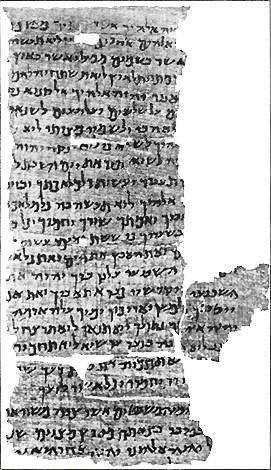
The Nash Papyrus (2nd century BC) contains a portion of a pre-Masoretic
Text, specifically the Ten Commandments and the Shema Yisrael
prayer.
Origin and
transmission
The Talmud
(and also Karaite mss.) states that a standard copy of the Hebrew
Bible was kept in the court of the Temple in Jerusalem for the
benefit of copyists; there were paid correctors of Biblical books
among the officers of the Temple (Talmud, tractate Ketubot 106a).
This copy is mentioned in the Aristeas Letter (§ 30; comp. Blau,
Studien zum Althebr. Buchwesen, p. 100); in the statements of Philo
(preamble to his "Analysis of the Political Constitution of the
Jews") and in Josephus (Contra Ap. i. 8).
Another
Talmudic story, perhaps referring to an earlier time, relates that
three Torah scrolls were found in the Temple court but were at
variance with each other. The differences were then resolved by
majority decision among the three.
Second
Temple period
The discovery
of the Dead Sea Scrolls at Qumran, dating from c.150 BC–AD 75,
shows however that in this period there was not always the
scrupulous uniformity of text that was so stressed in later
centuries. The scrolls show numerous small variations in
orthography, both as against the later Masoretic text, and between
each other. It is also evident from the notings of corrections and
of variant alternatives that scribes felt free to choose according
to their personal taste and discretion between different
readings.[3] However, despite these variations, most of the
Qumran fragments can be classified as being closer to the Masoretic
text than to any other text group that has survived. According to
Shiffman, 60% can be classed as being of proto-Masoretic type, and a
further 20% Qumran style with bases in proto-Masoretic texts,
compared to 5% proto-Samaritan type, 5% Septuagintal type, and 10%
non-aligned.[4] Furthermore, according to Haas, most of the texts
which vary from the Masoretic type, including four of the Septuagint
type manuscript fragments, were found in Cave 4. "This is the cave
where the texts were not preserved carefully in jars. It is
conjectured, that cave 4 was a geniza for the depositing of texts
that were damaged or had textual errors." [5] On the other hand,
some of the fragments conforming most accurately to the Masoretic
text were found in Cave 4.[6]
Rabbinic
period
An emphasis on
minute details of words and spellings, already used among the
Pharisees as bases for argumentation, reached its height with the
example of Rabbi Akiva (d. AD 135). The idea of a perfect text
sanctified in its consonantal base quickly spread throughout the
Jewish communities via supportive statements in Halakha, Aggada, and
Jewish thought;[3] and with it increasingly forceful strictures
leading ultimately to the statement in medieval times that a
deviation in even a single letter would make a Torah scroll
invalid.[7] Very few manuscripts are said to have survived the
destruction of Jerusalem in AD 70.[8] This both drastically reduced
the number of variants in circulation, and gave a new urgency that
the text must be preserved. New Greek translations were also made.
Unlike the Septuagint, large-scale deviations in sense between the
Greek of Aquila and Theodotion and what we now know as the Masoretic
text are minimal. Detailed variations between different Hebrew texts
in use still clearly existed though, as witnessed by differences
between the present-day Masoretic text and versions mentioned in the
Gemara, and often even Halachic midrashim based on spelling versions
which do not exist in the current Masoretic text.[3] (Mostly,
however, these variations are limited to whether particular words
should be written plene or defectively - i.e. whether a mater
lectionis consonant to represent a particular vowel sound should or
should not be included in a particular word at a particular point).
The Age of
the Masoretes
The current
received text finally achieved predominance through the reputation
of the Masoretes, schools of scribes and Torah scholars working
between the 7th and 11th centuries, based primarily in Palestine in
the cities of Tiberias and Jerusalem, and in Babylonia. These
schools developed such prestige for the accuracy and error-control
of their copying techniques that their texts established an
authority beyond all others.[3] Differences remained, sometimes
bolstered by systematic local differences in pronunciation and
cantillation. Every locality, following the tradition of its school,
had a standard codex embodying its readings. In Babylonia the school
of Sura differed from that of Nehardea; and similar differences
existed in the schools of the Land of Israel as against that at
Tiberias, which in later times increasingly became the chief seat of
learning. In this period living tradition ceased, and the Masoretes
in preparing their codices usually followed the one school or the
other, examining, however, standard codices of other schools and
noting their differences.
ben Asher
and ben Naphtali
In the first
half of the tenth century Aaron ben Moses ben Asher and Moshe ben
Naphtali (often just called ben Asher and ben Naphtali) were the
leading Masoretes in Tiberias. Their names have come to symbolise
the variations among Masoretes, but the differences between ben
Asher and ben Naphtali should not be exaggerated. There are hardly
any differences between them regarding the consonants, though they
differ more on vocalization and accents. Also, there were other
authorities such as Rabbi Pinchas and Moshe Moheh, and ben Asher and
ben Naphtali often agree against these others. Further, it is
possible that all variations found among manuscripts eventually came
to be regarded as disagreements between these figureheads. Ben Asher
wrote a standard codex (the Aleppo Codex) embodying his opinions.
Probably ben Naphtali did too, but it has not survived.
It has been
suggested that there never was an actual "ben Naphtali"; rather, the
name was chosen (based on the Bible, where Asher and Naphtali are
the younger sons of Zilpah and Bilhah) to designate any tradition
different from Ben Asher's. This is unlikely, as there exist lists
of places where ben Asher and ben Naphtali agree against other
authorities.
Ben Asher was
the last of a distinguished family of Masoretes extending back to
the latter half of the eighth century. Despite the rivalry of ben
Naphtali and the opposition of Saadia Gaon, the most eminent
representative of the Babylonian school of criticism, ben Asher's
codex became recognized as the standard text of the Bible.
The Middle
Ages
The two rival
authorities, ben Asher and ben Naphtali, practically brought the
Masorah to a close. Very few additions were made by the later
Masoretes, styled in the thirteenth and fourteenth centuries
Naḳdanim, who revised the works of the copyists, added the vowels
and accents (generally in fainter ink and with a finer pen) and
frequently the Masorah.
Considerable influence on the development and spread of Masoretic
literature was exercised during the eleventh, twelfth, and
thirteenth centuries by the Franco-German school of Tosafists.
R. Gershom, his brother Machir, Joseph ben Samuel Bonfils (Tob
'Elem) of Limoges, R. Tam (Jacob ben Meïr), Menahem ben Perez of
Joigny, Perez ben Elijah of Corbeil, Judah of Paris, Meïr Spira, and
R. Meïr of Rothenburg made Masoretic compilations, or additions to
the subject, which are all more or less frequently referred to in
the marginal glosses of Biblical codices and in the works of Hebrew
grammarians. Many believe that the ben Asher family were Karaites.
Masorah
By long
tradition, a ritual Torah scroll shall contain only the Hebrew
consonantal text - nothing may be added, nothing taken away.
However, perhaps because they were intended for personal study
rather than ritual use, the Masoretic codices provide extensive
additional material, called masorah, to show correct pronunciation
and cantillation, protect against scribal errors, and annotate
possible variants. The manuscripts thus include vowel points,
pronunciation marks and stress accents in the text, short
annotations in the side margins, and longer more extensive notes in
the upper and lower margins and collected at the end of each book.
Etymology
The Hebrew
word masorah is taken from Ezekiel 20:37 and means originally
"fetter". The fixation of the text was considered to be in the
nature of a fetter upon its exposition. When, in the course of time,
the Masorah had become a traditional discipline, the term became
connected with the verb ( = "to hand down"), and acquired the
general meaning of "tradition."
Language
and form
The language
of the Masoretic notes is partly Hebrew and partly Aramaic. The
Masoretic annotations are found in various forms: (a) in separate
works, e.g., the Oklah we-Oklah; (b) in the form of notes written in
the margins and at the end of codices. In rare cases, the notes are
written between the lines. The first word of each Biblical book is
also as a rule surrounded by notes. The latter are called the
Initial Masorah; the notes on the side margins or between the
columns are called the Small or Inner Masorah; and those on the
lower and upper margins, the Large or Outer Masorah. The name "Large
Masorah" is applied sometimes to the lexically arranged notes at the
end of the printed Bible, usually called the Final Masorah, or the
Masoretic Concordance.
The Small
Masorah consists of brief notes with reference to marginal readings,
to statistics showing the number of times a particular form is found
in Scripture, to full and defective spelling, and to abnormally
written letters. The Large Masorah is more copious in its notes. The
Final Masorah comprises all the longer rubrics for which space could
not be found in the margin of the text, and is arranged
alphabetically in the form of a concordance. The quantity of notes
the marginal Masorah contains is conditioned by the amount of vacant
space on each page. In the manuscripts it varies also with the rate
at which the copyist was paid and the fanciful shape he gave to his
gloss.
In most
manuscripts, there are some discrepancies between the text and the
masorah, suggesting that they were copied from different sources or
that one of them has copying errors. The lack of such discrepancies
in the Aleppo Codex is one of the reasons for its importance; the
scribe who copied the notes, presumably Aaron ben Moses ben Asher,
probably wrote them originally.
Numerical
Masorah
In classical
antiquity, copyists were paid for their work according to the number
of stichs (lines of verse). As the prose books of the Bible were
hardly ever written in stichs, the copyists, in order to estimate
the amount of work, had to count the letters. For the Masoretic
Text, such statistical information more importantly also ensured
accuracy in the transmission of the text with the production of
subsequent copies that were done by hand.
Hence the
Masoretes contributed the Numerical Masorah. These notes are
traditionally categorized into two main groups: the marginal Masorah
and the final Masorah. The category of marginal Masorah is further
divided into the Masorah parva (small Masorah) in the outer side
margins and the Masorah magna (large Masorah), traditionally located
at the top and bottom margins of the text.
The Masorah
parva is a set of statistics in the outer side margins of the text.
Beyond simply counting the letters, the Masorah parva consists of
word-use statistics, similar documentation for expressions or
certain phraseology, observations on full or defective writing,
references to the Kethiv-Qere readings and more. These observations
are also the result of a passionate zeal to safeguard the accurate
transmission of the sacred text.
The Masorah
magna, in measure, is an expanded Masorah parva. It is not printed
in BHS.
The final
Masorah is located at the end of biblical books or after certain
sections of the text, such as at the end of the Torah. It contains
information and statistics regarding the number of words in a book
or section, etc.
Thus
(Leviticus 8:23) is the middle verse in the Pentateuch; all the
names of Divinity mentioned in connection with Abraham are holy
except (Genesis 18:3); ten passages in the Pentateuch are dotted;
three times the Pentateuch has the spelling לא where the reading is
לו. The collation of manuscripts and the noting of their differences
furnished material for the Text-Critical Masorah. The close relation
which existed in earlier times (from the Soferim to the Amoraim
inclusive) between the teacher of tradition and the Masorete, both
frequently being united in one person, accounts for the Exegetical
Masorah. Finally, the invention and introduction of a graphic system
of vocalization and accentuation gave rise to the Grammatical
Masorah.
The most
important of the Masoretic notes are those that detail the
Kethiv-Qere that are located in the Masorah parva in the outside
margins of BHS. Given that the Masoretes would not alter the sacred
consonantal text, the Kethiv-Qere notes were a way of "correcting"
or commenting on the text for any number of reasons (grammatical,
theological, aesthetic, etc.) deemed important by the copyist.
[Reference: Pratico and Van Pelt, Basics of Biblical Hebrew,
Zondervan. 2001. p406ff]
Fixing of
the text
The earliest
labors of the Masoretes included standardizing division of the text
into books, sections, paragraphs, verses, and clauses (probably in
the chronological order here enumerated); the fixing of the
orthography, pronunciation, and cantillation; the introduction or
final adoption of the square characters with the five final letters
(comp. Numbers and Numerals); some textual changes to guard against
blasphemy and the like (though these changes may pre-date the
Masoretes - see Tikkune Soferim); the enumeration of letters, words,
verses, etc., and the substitution of some words for others in
public reading.
Since no
additions were allowed to be made to the official text of the Bible,
the early Masoretes adopted other expedients: e.g., they marked the
various divisions by spacing, and gave indications of halakic and
haggadic teachings by full or defective spelling, abnormal forms of
letters, dots, and other signs. Marginal notes were permitted only
in private copies, and the first mention of such notes is found in
the case of R. Meïr (c. AD 100-150).
Tikkune
Soferim
Early
rabbinic sources, from around AD 200, mention several passages of
Scripture in which the conclusion is inevitable that the ancient
reading must have differed from that of the present text. The explanation of this
phenomenon is given in the expression ("Scripture has used
euphemistic language," i.e. to avoid anthropomorphism and
anthropopathy).
Rabbi Simon ben Pazzi (third century) calls these readings
"emendations of the Scribes" (tikkune Soferim; Midrash Genesis
Rabbah xlix. 7), assuming that the Scribes actually made the
changes. This view was adopted by the later Midrash and by the
majority of Masoretes. In Masoretic works these changes are ascribed
to Ezra; to Ezra and Nehemiah; to Ezra and the Soferim; or to Ezra,
Nehemiah, Zechariah, Haggai, and Baruch. All these ascriptions mean
one and the same thing: that the changes were assumed to have been
made by the Men of the Great Synagogue.
The term
tikkun Soferim has been understood by different scholars in various
ways. Some regard it as a correction of Biblical language authorized
by the Soferim for homiletical purposes. Others take it to mean a
mental change made by the original writers or redactors of
Scripture; i.e. the latter shrank from putting in writing a thought
which some of the readers might expect them to express.
The assumed
emendations are of four general types:
-
Removal
of unseemly expressions used in reference to God; e.g., the
substitution of ("to bless") for ("to curse") in certain
passages.
-
Safeguarding of the Tetragrammaton; e.g. substitution of "Elohim"
for "YHVH" in some passages.
-
Removal
of application of the names of pagan gods, e.g. the change of
the name "Ishbaal" to "Ishbosheth."
-
Safeguarding the unity of divine worship at Jerusalem.
Mikra and
ittur
Among the
earliest technical terms used in connection with activities of the
Scribes are the "mikra Soferim" and "ittur Soferim." In the geonic
schools, the first term was taken to signify certain vowel-changes
which were made in words in pause or after the article; the second,
the cancellation in a few passages of the "vav" conjunctive, where
it had by some been wrongly read. The objection to such an
explanation is that the first changes would fall under the general
head of fixation of pronunciation, and the second under the head of
"Qere" and "Ketiv". Various explanations have, therefore, been
offered by ancient as well as modern scholars without, however,
succeeding in furnishing a completely satisfactory solution.
Suspended
letters and dotted words
There are four
words having one of their letters suspended above the line. One of
them, (Judges 18:30), is due to an alteration of the original out of
reverence for Moses; rather than say that Moses' grandson became an
idolatrous priest, a suspended nun was inserted to turn Mosheh into
Menasheh (Manasseh). The origin of the other three (Psalms 80:14;
Job 38:13, 15) is doubtful. According to some, they are due to
mistaken majuscular letters; according to others, they are later
insertions of originally omitted weak consonants.
In fifteen
passages in the Bible, some words are stigmatized; i.e., dots appear
above the letters. (Gen 16:5, 18:9, 19:33, 33:4, 37:12, Num 3:39,
9:10, 21:30, 29:15, Deut. 29:28, 2Sam 19:20, Isaiah 44:9, Ez 41:20,
46:22, Ps 27:13) The significance of the dots is disputed. Some hold
them to be marks of erasure; others believe them to indicate that in
some collated manuscripts the stigmatized words were missing, hence
that the reading is doubtful; still others contend that they are
merely a mnemonic device to indicate homiletical explanations which
the ancients had connected with those words; finally, some maintain
that the dots were designed to guard against the omission by
copyists of text-elements which, at first glance or after comparison
with parallel passages, seemed to be superfluous. Instead of dots
some manuscripts exhibit strokes, vertical or else horizontal. The
first two explanations are unacceptable for the reason that such
faulty readings would belong to Qere and Ketiv, which, in case of
doubt, the majority of manuscripts would decide. The last two
theories have equal probability.
Inverted
letters
In nine
passages of the Bible are found signs usually called "inverted
nuns," because they resemble the Hebrew letter nun ( נ ) written in
some inverted fashion. The exact shape varies between different
manuscripts and printed editions. In many manuscripts, a reversed
nun is found—referred to as a "nun hafucha" by the masoretes. In
some earlier printed editions, they are shown as the standard nun
upside down or rotated, because the printer did not want to bother
to design a character to be used only nine times. The recent
scholarly editions of the Masoretic Text show the reversed nun as
described by the masoretes. In some manuscripts, however, other
symbols are occasionally found instead. These are sometimes referred
to in rabbinical literature as "simaniyot," (markers).
The primary
set of inverted nuns is found surrounding the text of Numbers
10:35-36. The Mishna notes that this text is 85 letters long and
dotted. This demarcation of this text leads to the later use of the
inverted nun markings. Saul Lieberman demonstrated that similar
markings can be found in ancient Greek texts where they are also
used to denote 'short texts'. During the Medieval period, the
inverted nuns were actually inserted into the text of the early
Rabbinic Bibles published by Bomberg in the early 16th century. The
talmud records that the markings surrounding Numbers 10:35 - 36 were
thought to denote that this 85 letter text was not in its proper
place. One opinion goes so far as to say that it would appear in
another location in a later edition of the Torah!
Bar Kappara is
known to have considered our Torah as comprised of 7 volumes in the
Gemara "The seven pillars with which Wisdom built her house (Prov.
9:1) are the seven Books of Moses". Genesis, Exodus and Leviticus
and Deuteronomy as we know them but Numbers was really 3 separate
volumes Num 1:1 to Num 10:35 followed by Number 10:35-36 and the
third text from there to the end of Numbers.
The 85 letter
text is also said to be denoted because it is the model for the
least number of letters which constitute a 'text' which one would be
required to save from fire due to its holiness.
History of
the Masorah
The history of
the Masorah may be divided into three periods: (1) creative period,
from its beginning to the introduction of vowel-signs; (2)
reproductive period, from the introduction of vowel-signs to the
printing of the Masorah (1525); (3) critical period, from 1525
to the present time.
The materials
for the history of the first period are scattered remarks in
Talmudic and Midrashic literature, in the post-Talmudical treatises
Masseket Sefer Torah and Masseket Soferim, and in a Masoretic chain
of tradition found in ben Asher's "Diḳduḳe ha-Ṭe'amim," § 69 and
elsewhere.
Critical
study
Jacob ben
Hayyim ibn Adonijah, having collated a vast number of manuscripts,
systematized his material and arranged the Masorah in the second
Bomberg edition of the Bible (Venice, 1524-25). Besides introducing
the Masorah into the margin, he compiled at the close of his Bible a
concordance of the Masoretic glosses for which he could not find
room in a marginal form, and added an elaborate introduction – the
first treatise on the Masorah ever produced. In spite of its
numerous errors, this work has been considered by some as the "textus
receptus" of the Masorah (Würthwein 1995:39), and was used for the
English translation of the Old Testament for the King James Version
of the Bible.
Next to Ibn
Adonijah the critical study of the Masorah has been most advanced by
Elijah Levita, who published his famous "Massoret ha-Massoret" in
1538. The "Tiberias" of the elder Buxtorf (1620) made Levita's
researches more accessible to a Christian audience. The eighth
prolegomenon to Walton's Polyglot Bible is largely a réchauffé of
the "Tiberias". Levita compiled likewise a vast Masoretic
concordance, "Sefer ha-Zikronot," which still lies in the National
Library at Paris unpublished. The study is indebted also to R. Meïr
b. Todros ha-Levi (RaMaH), who, as early as the thirteenth century,
wrote his "Sefer Massoret Seyag la-Torah" (correct ed. Florence,
1750); to Menahem Lonzano, who composed a treatise on the Masorah of
the Pentateuch entitled "Or Torah"; and in particular to Jedidiah
Norzi, whose "Minḥat Shai" contains valuable Masoretic notes based
on a careful study of manuscripts.
The Dead
Sea Scrolls have shed new light on the history of the Masoretic
Text. Many texts found there, especially those from Masada, are
quite similar to the Masoretic Text, suggesting that an ancestor of
the Masoretic Text was indeed extant as early as the 2nd century BC.
However, other texts, including many of those from Qumran, differ
substantially, indicating that the Masoretic Text was but one of a
diverse set of Biblical writings (Lane Fox 1991:99-106; Tov
1992:115). §Among the rejected books by both the Judaic and Catholic
canons was found the Book of Enoch, the Manual of Discipline or
"Rule of the Community" (1QS) and the "The War of the Sons of Light
Against the Sons of Darkness." (1QM).[9]
Some
important editions
There have
been very many published editions of the Masoretic text; this is a
list of some of the most important.
-
Daniel
Bomberg, ed. Jacob ben Hayyim ibn Adonijah, 1524-1525, Venice
The second Rabbinic Bible, which served as the base for all
future editions. This was the source text used by the
translators of the King James Version in 1611 and the New King
James Version in 1982.[10]
-
Everard
van der Hooght, 1705, Amsterdam and Utrecht
This was practically a reprint of the Athias-Leusden edition of
1667; but at the end it has variants taken from a number of
printed editions. It has been much prized because of its
excellent and clear type; but no manuscripts were used in its
preparation. Nearly all 18th century and 19th century Bibles
were almost exact reprints of this edition.
-
Benjamin
Kennicott, 1776, Oxford
As well as the van der Hooght text, this included the Samaritan
Pentateuch and a huge collection of variants from manuscripts
and early printed editions; while this collection has many
errors, it is still of some value. The collection of variants
was corrected and extended by Johann Bernard de Rossi (1784–8),
but his publications gave only the variants without a complete
text.
-
Meir
Letteris, 1852; 2nd edition, 1866 (published British and Foreign
Bible Society)
The 1852 edition was yet another copy of van der Hooght. The
1866 edition, however, was carefully checked against old
manuscripts. It is probably the most widely reproduced text of
the Hebrew Bible in history, with many dozens of authorised
reprints and many more pirated and unacknowledged ones.
-
Seligman
Baer and Franz Delitzsch, 1869–1895 (Exodus to Deuteronomy never
appeared)
-
Christian
David Ginsburg, 1894; 2nd edition, 1908–1926
The first edition was very close to the second Bomberg edition,
but with variants added from a number of manuscripts and all of
the earliest printed editions, collated with far more care than
the work of Kennicott; he did all the work himself. The second
edition diverged slightly more from Bomberg, and collated more
manuscripts; he did most of the work himself, but failing health
forced him to rely partly on his wife and other assistants.[11]
-
Biblia
Hebraica, first two editions, 1906, 1912; virtually identical to
the second Bomberg edition but with variants from Hebrew sources
and early translations in the footnotes
-
Biblia
Hebraica, third edition based on the Leningrad Codex, 1937
-
Umberto
Cassuto, 1953 (based on Ginsburg 2nd edition but revised based
on the Aleppo Codex, Leningrad Codex and other early manuscipts)
-
Norman
Snaith, 1958 (published British and Foreign Bible Society)
Snaith based it on Sephardi manuscripts such as British Museum
Or. 2626-28, and said that he had not relied on Letteris.
However, it has been shown that he must have prepared his copy
by amending a copy of Letteris, because while there are many
differences, it has many of the same typographical errors as
Letteris. Snaith's printer even went so far as to break printed
vowels to match the broken characters in Letteris. Snaith
combined the accent system of Letteris with the system found in
Sephardi manuscripts, thereby creating accentuation patterns
found nowhere else in any manuscript or printed edition.
-
Hebrew
University Bible Project, 1965-
Started by Moshe Goshen-Gottstein, this follows the text of the
Aleppo Codex where extant and otherwise the Leningrad Codex. It
includes a wide variety of variants from the Dead Sea Scrolls,
Septuagint, early Rabbinic literature and selected early
mediaeval manuscripts. So far, only Isaiah, Jeremiah and Ezekiel
have been published.
-
The Koren
Bible by Koren Publishers Jerusalem, 1962
The text was derived by comparing a number of printed Bibles,
and following the majority when there were discrepancies.
-
Aron Dotan,
based on the Leningrad Codex, 1976
-
Biblia
Hebraica Stuttgartensia, revision of Biblia Hebraica (third
edition), 1977
-
Mordechai
Breuer, based on the Aleppo Codex, 1977–1982
-
The
Jerusalem Crown, 2001: this is a revised version of Breuer, and
is the official version used in inaugurating the President of
Israel
-
Biblia
Hebraica Quinta, revision of Biblia Hebraica Stuttgartensia;
only three volumes (Five Megilloth, Ezra and Nehemiah,
Deuteronomy) have been published so far.
Hebrew Bible
Q're perpetuum
Samaritan Pentateuch
Micrography Decorative illustrations often made using the text of
the Mesorah in medieval Pentateuch codexes.
Parashah
[edit] References
1. Pope Pius XII on 3 September 1943 decreed the Divino
Afflante Spiritu which allowed Catholic translations based on other
versions than just the Latin Vulgate, notably in English the New
American Bible.
2. A seventh century fragment containing the Song of the Sea
(Exodus 13:19-16:1) is one of the few surviving texts from the
"silent era" of Hebrew biblical texts between the Dead Sea Scrolls
and the Aleppo Codex. See "Rare scroll fragment to be unveiled,"
Jerusalem Post, May 21, 2007.
3. a b c d Menachem Cohen, The Idea of the Sanctity of the
Biblical Text and the Science of Textual Criticism in HaMikrah
V'anachnu, ed. Uriel Simon, HaMachon L'Yahadut U'Machshava Bat-Z'mananu
and Dvir, Tel-Aviv, 1979
4. Shiffman, Reclaiming the Dead Sea Scrolls
5. Gretchen Haas[citation needed]
6. Ulrich, E., Cross, F. M., Davila, J. R., Jastram, N.,
Sanderson, J. E., Tov, E. and Strugnell, J. (1994). Qumran Cave 4,
VII, Genesis to Numbers. Discoveries in the Judaean Desert 12.
Clarendon Press, Oxford.
7. Rambam, The Laws of Tefillin, Mezuzot, and Torah Scrolls,
1:2
8. Sir Godfrey Driver, Introduction to the Old Testament of
the New English Bible, 1970
9. Mansoor, Menahem. The Dead Sea Scrolls. Grand Rapids,
Michigan and Driver, G. R., The Judaean Scrolls. Great Britain:
Oxford, 1965.
10. Price, James D. (1994-02-14). "This file is a letter I
wrote to Mrs. Ripplinger in 1994 in response to her book, New Age
Bible Versions. It deals primarily with her criticism of the New
King James Version." (MS Word). James D. Price Publications. http://www.jamesdprice.com/images/Ripplinger_February_15,_1994.doc.
Retrieved 2009-03-18. "But regardless of these details, as former
executive editor of the NKJV Old Testament, I can confidently assure
you that the NKJV followed, as carefully as possible, the Bobmerg
1524-25 Ben Chayyim edition that the KJV 1611 translators used--I
personally made sure."
11. "Introduction to the Ginsburg Edition of the Hebrew Old
Testament", British and Foreign Bible Society, 1928.
[edit] Literature cited
Lane Fox, Robin (1991). The Unauthorized Version. Alfred A. Knopf.
pp. 99–106. ISBN 0-394-57398-6.
Tov, Emanuel (1992). Textual Criticism of the Hebrew Bible. Fortress
press. ISBN 0-8006-3429-2.
Würthwein, Ernst (1995). The Text of the Old Testament. Fortress
press. ISBN 0-8028-0788-7.
[edit] External links
Jewish Encyclopedia: Masorah
Dr. Christian David Ginsburg's 1880 edition of the Massorah (PDF)
Nahum M. Sarna and S. David Sperling (2006), Text, in Bible,
Encyclopedia Judaica 2nd ed.; via Jewish Virtual Library
Christian canons of the Bible
The Christian
Bible consists of the Hebrew scriptures, which have been called the Old
Testament, and some later writings known as the New Testament.
"Testament" is a translation of the Greek διαθηκη (diatheke), also often
translated "covenant." It is a legal term denoting a formal and legally
binding declaration of benefits to be given by one party to another
(e.g., "last will and testament" in secular use). Here it does not
connote mutuality; rather, it is a unilateral covenant offered by God to
individuals.[5]
Some groups within
Christianity include additional books as part of one or both of these
"Testaments" of their sacred writings—most prominent among which are the
biblical apocrypha or deuterocanonical books.
Significant
versions of the English Christian Bible include the KJV, the NKJV, the
NIV, and the TNIV.
In Judaism, the
term Christian Bible is commonly used to identify only those books like
the New Testament which have been added by Christians to the Masoretic
Text, and excludes any reference to an Old Testament.[9]
Old Testament
The Old Testament
consists of a collection of works written in classical Hebrew, except
some brief portions (Ezra 4:8–6:18 and 7:12–26, Jeremiah 10:11, Daniel
2:4–7:28) which are in the Aramaic language, a sister language which
became the lingua franca of the Semitic world.[10] Much of it, such as
genealogies, poems and stories, are thought to have been handed down by
word of mouth for many generations.
The Old Testament
is accepted by Christians as scripture. Broadly speaking, it is the same
as the Hebrew Bible. However, the order of the books is not entirely the
same as that found in Hebrew manuscripts and in the ancient versions.
and varies from Judaism in interpretation and emphasis (see for example
Isaiah 7:14). Several Christian denominations also incorporate
additional books into their canons of the Old Testament. A few groups
consider particular translations to be divinely inspired, notably
the Greek Septuagint, the Aramaic Peshitta, and the English King James
Version.
Apocryphal or
deuterocanonical books
The Septuagint
(Greek translation, from
Alexandria in Egypt under the Ptolemies)
was generally abandoned in favour of the Masoretic text as the basis for
translations of the Old Testament into Western languages from St.
Jerome's Bible (the Vulgate) to the present day. In Eastern
Christianity, translations based on the Septuagint still prevail. Some
modern Western translations make use of the Septuagint to clarify
passages in the Masoretic text, where the Septuagint may preserve a
variant reading of the Hebrew text. They also sometimes adopt variants
that appear in other texts e.g. those discovered among the Dead Sea
Scrolls.
Septuagint
The Septuagint (pronounced /ˈsɛptʊ.ədʒɪnt/), or simply "LXX",
referred to in critical works by the abbreviation ,[1] is the
Koine Greek version of the Hebrew Bible, translated in stages
between the 3rd and 1st centuries BCE in Alexandria.[2] It was begun
by the third century BCE and completed before 132 BCE.[3]
It is the
oldest of several ancient translations of the Hebrew Bible into
Greek, lingua franca of the eastern Mediterranean Basin from the
time of Alexander the Great (356-323 BCE).
The Septuagint
was held in great respect in ancient times; Philo and Josephus
(associated with Hellenistic Judaism) ascribed divine inspiration to
its authors.[4] Besides the Old Latin versions, the LXX is also the
basis for the Slavonic, the Syriac, Old Armenian, Old Georgian and
Coptic versions of the Old Testament.[5] Of significance for all
Christians and for Bible scholars, the LXX is quoted by the New
Testament and by the Apostolic Fathers.
Creation of
the Septuagint
Jewish
scholars (see also Hellenistic Judaism) first translated the Torah
into Koine Greek in the third century BCE[6]. According to the
record in the Talmud,
'King
Ptolemy once gathered 72 Elders. He placed them in 72 chambers,
each of them in a separate one, without revealing to them why
they were summoned. He entered each one's room and said: 'Write
for me the Torah of Moshe, your teacher.' God put it in the
heart of each one to translate identically as all the others
did'[7]
Further books
were translated over the next two centuries. It is not altogether
clear which was translated when, or where; some may even have been
translated twice, into different versions, and then revised.[8] The
quality and style of the different translators also varied
considerably from book to book, from the literal to paraphrasing to
interpretative. According to one assessment "the Pentateuch is
reasonably well translated, but the rest of the books, especially
the poetical books, are often very poorly done and even contain
sheer absurdities".[9]
As the work
of translation progressed gradually, and new books were added to the
collection, the compass of the Greek Bible came to be somewhat
indefinite. The Pentateuch always maintained its pre-eminence as the
basis of the canon; but the prophetic collection (out of which
the Nevi'im were selected) changed its aspect by having various
hagiographa incorporated into it. Some of the newer works, those
called anagignoskomena in Greek, are not included in the Jewish
canon. Among these books are Maccabees and the Wisdom of Ben Sira.
Also, the Septuagint version of some works, like Daniel and
Esther, are longer than those in the Masoretic Text.[10] Some of the
later books (Wisdom of Solomon, 2 Maccabees, and others) apparently
were composed in Greek.[11]
The authority of the larger group of "writings", out of which the
ketuvim were selected, had not yet been determined, although some
sort of selective process must have been employed because the
Septuagint did not include other well-known Jewish documents such as
Enoch or Jubilees or other writings that are now part of the
Pseudepigrapha. It is not known what principles were used to
determine the contents of the Septuagint beyond the "Law and the
Prophets", a phrase used several times in the New Testament.
Pseudepigraph
Pseudepigrapha are falsely attributed works, texts whose claimed
authorship is unfounded; a work, simply, "whose real author
attributed it to a figure of the past."[1] The word "pseudepigrapha"
(from the Greek: ψευδής, pseudēs, "false" and ἐπιγραφή,
epigraphē, "inscription"; see the related epigraphy) is the
plural of "pseudepigraphon" (sometimes Latinized as "pseudepigraphum");
the Anglicized forms "pseudepigraph" and "pseudepigraphs" are
also used.
The Book
of Enoch is an example of a pseudepigraph; no Hebrew scholars
would ascribe its authorship to Enoch, a figure mentioned in
Genesis 5. Nevertheless, in some cases, especially for books
belonging to a religious canon, the question of whether a text
is pseudepigraphical or not elicits sensations of loyalty and
can become a matter of heavy dispute. The authenticity or value
of the work itself, which is a separate question for experienced
readers, often becomes sentimentally entangled in the
association. Though the inherent value of the text may not be
called into question, the weight of a revered or even apostolic
author lends authority to a text: in Antiquity pseudepigraphy
was "an accepted and honored custom practiced by
students/admirers of a revered figure".[2] This is the
essential motivation for pseudepigraphy in the first place.
Pseudepigraphy covers the false ascription of names of authors
to works, even to perfectly authentic works that make no such
claim within their text. Thus a widely accepted but incorrect
attribution of authorship may make a perfectly authentic text
pseudepigraphical. Assessing the actual writer of a text brings
questions of pseudepigraphical attributions within the
discipline of literary criticism. In a parallel case, forgers
have been known to improve the market value of a perfectly
genuine 17th-century Dutch painting by adding a painted
signature Rembrandt fecit.
On a
related note, a famous name assumed by the author of a work
is an allonym.
These are
the basic and original meanings of the terms.
In
Biblical studies, the Pseudepigrapha are Jewish religious works
written c 200 BC to 200 AD, not all of which are literally
pseudepigraphical.[3] They are distinguished by Protestants from
the Deuterocanonical (Catholic and Orthodox) or Apocrypha
(Protestant), the books that appear in the Septuagint and
Vulgate but not in the Hebrew Bible or in Protestant Bibles.[3]
Catholics distinguish only between the Deuterocanonical and all
the other books, that are called Apocrypha, a name that is used
also for the Pseudepigrapha in the Catholic usage.
Classical and Biblical studies
There have
probably been pseudepigrapha almost from the invention of full
writing. For example ancient Greek authors often refer to texts
which claimed to be by Orpheus or his pupil Musaeus but which
attributions were generally disregarded. Already in Antiquity
the collection known as the "Homeric hymns" was recognized as
pseudepigraphical, that is, not actually written by Homer.
Literary studies
In secular
literary studies, when works of Antiquity have been demonstrated
not to have been written by the authors to whom they have
traditionally been ascribed, some writers apply the prefix
pseudo- to their names. Thus the encyclopedic compilation of
Greek myth called Bibliotheke is often now attributed, not to
Apollodorus, but to "pseudo-Apollodorus" and the Catasterismi,
recounting the translations of mythic figure into asterisms and
constellations, not to the serious astronomer Eratosthenes, but
to a "pseudo-Eratosthenes". The prefix may be abbreviated, as in
"ps-Apollodorus" or "ps-Eratosthenes".
Biblical studies
In
Biblical studies, pseudepigrapha refers particularly to works
which purport to be written by noted authorities in either the
Old and New Testaments or by persons involved in Jewish or
Christian religious study or history. These works can also be
written about Biblical matters, often in such a way that they
appear to be as authoritative as works which have been included
in the many versions of the Judeo-Christian scriptures.
Eusebius of Caesarea indicates this usage dates back at least to
Serapion, bishop of Antioch)[clarification needed] whom Eusebius
records[4] as having said: "But those writings which are falsely
inscribed with their name (ta pseudepigrapha), we as experienced
persons reject...."
Many such
works were also referred to as Apocrypha, which originally
connoted "secret writings", those that were rejected for
liturgical public reading. An example of a text that is both
apocryphal and pseudepigraphical is the Odes of Solomon,
pseudepigraphical because it was not actually written by Solomon
but instead is a collection of early Christian (first to second
century) hymns and poems, originally written not in Hebrew, and
apocryphal because not accepted in either the Tanach or the New
Testament.
But
Protestants have also applied the word Apocrypha to texts found
in the Roman Catholic and Orthodox scriptures which were not
found in Hebrew manuscripts. Roman Catholics called those texts
"deuterocanonical". Accordingly, there arose in some Protestant
Biblical scholarship an extended use of the term pseudepigrapha
for works that appeared as though they ought to be part of the
Biblical canon, because of the authorship ascribed to them, but
which stood outside both the Biblical canons recognized by
Protestants and Catholics. These works were also outside the
particular set of books that Roman Catholics called
deuterocanonical and to which Protestants had generally applied
the term Apocryphal. Accordingly, the term pseudepigraphical, as
now used often among both Protestants and Roman Catholics
(allegedly for the clarity it brings to discussion), may make it
difficult to discuss questions of pseudepigraphical authorship
of canonical books dispassionately with a lay audience. To
confuse the matter even more, Orthodox Christians accept books
as canonical that Roman Catholics and most Protestant
denominations consider pseudepigraphical or at best of much less
authority. There exist also churches that reject some of the
books that Roman Catholics, Orthodox and Protestants accept. The
same is true of some Jewish sects.[clarification needed]
There is a
tendency not to use the word pseudepigrapha when describing
works later than about 300 AD when referring to Biblical
matters. But the late-appearing Gospel of Barnabas, Apocalypse
of Pseudo-Methodius, the Pseudo-Apuleius (author of a
fifth-century herbal ascribed to Apuleius), and the author
traditionally referred to as the "Pseudo-Dionysius the
Areopagite", are classic examples of pseudepigraphy. In the
fifth century the moralist Salvian published Contra avaritiam
under the name of Timothy; the letter in which he explained to
his former pupil, Bishop Salonius, his motives for so doing
survives.[5] There is also a category of modern pseudepigrapha.
Examples
of Old Testament pseudepigrapha are the Ethiopian Book of Enoch,
Jubilees (both of which are canonical in the Abyssinian Church
of Ethiopia); the Life of Adam and Eve and the Pseudo-Philo.
Examples of New Testament pseudepigrapha (but in these cases
also likely to be called New Testament Apocrypha) are the Gospel
of Peter and the attribution of the Epistle to the Laodiceans to
Paul. Further examples of New Testament pseudepigrapha include
the aforementioned Gospel of Barnabas, and the Gospel of Judas,
which begins by presenting itself as "the secret account of the
revelation that Jesus spoke in conversation with Judas
Iscariot".
Biblical Pseudepigrapha
The
term Pseudepigrapha commonly refers to numerous works of Jewish
religious literature written from about 200 BC to 200 AD.[3]
Not all of these works are actually pseudepigraphical.[3] Such
works include the following:[3]
-
3
Maccabees
-
4
Maccabees
-
Assumption of Moses
-
Ethiopic Book of Enoch (1 Enoch)
-
Slavonic Book of Enoch (2 Enoch)
-
Book
of Jubilees
-
Greek
Apocalypse of Baruch (3 Baruch)
-
Letter
of Aristeas
-
Life
of Adam and Eve
-
Martyrdom and Ascension of Isaiah
-
Psalms
of Solomon
-
Sibylline Oracles
-
Syriac
Apocalypse of Baruch (2 Baruch)
-
Testaments of the Twelve Patriarchs
Notes
1.
Bauckham, Richard; "Pseudo-Apostolic Letters", Journal of
Biblical Literature, Vo. 107, No. 3, September 1988, pp.469–494.
2. Colossians as Pseudepigraphy (Bible Seminar, 4
Sheffield:JSOT Press) 1986, p. 12.[not specific enough to
verify]
3. Harris, Stephen L., Understanding the Bible. Palo Alto:
Mayfield. 1985.
4. Eusebius, Historia Ecclesiae 6,12.
5. Salvian, Epistle, ix.
References
-
von
Fritz, Kurt, ed. Pseudepigraphica. 1 (Geneva:Fondation Hardt).
Contributions on pseudopythagorica (the literature ascribed
to Pythagoras), the Platonic Epistles, Jewish-Hellenistic
literature, and the characteristics particular to religious
forgeries.
-
Kiley,
Mark. Colossians as Pseudepigraphy (Bible Seminar, 4
Sheffield:JSOT Press) 1986. Colossians as a non-deceptive
school product.
-
Metzger, B.M. "Literary forgeries and canonical
pseudepigrapha", Journal of Biblical Literature 91 (1972).
Naming and
designation
The
Septuagint derives its name from Latin Interpretatio septuaginta
virorum, (Greek: ἡ μετάφρασις τῶν ἑβδομήκοντα, hē metáphrasis tōn
hebdomēkonta), "translation of the seventy interpreters".[2]
As stated in
the Tractate Megillah of the Babylonian Talmud (pages 9a-9b), and
later narrated by Philo of Alexandria, 72 Jewish translators were
used to complete the translation while kept in separate chambers.
They all produced identical versions of the text in seventy-two
days. This story underlines the fact that Jews in antiquity
wished to present the translation as authoritative in order to
prevent criticism by non-Jews based on divergent translations.[4]
The text in Megillah identifies fifteen specific unusual
translations made by the scholars. Only two of these translations
are found in the extant LXX.
The word
septuaginta[12] means "seventy" in Latin (hence the abbreviation LXX),
based on the Jewish source for the translation event that refers to
the account, also found in the pseudepigraphic Letter of Aristeas
which repeats the story of how seventy-two Jewish scholars were
forced [??] [13] by
the Greek King of Egypt Ptolemy II Philadelphus in the 3rd century
BCE to translate the Torah (or Pentateuch) from Biblical Hebrew into
Greek for inclusion in the Library of Alexandria.[4] In Hebrew it is
known as Targum Shiv'im - "the translation of the 70".
Letter
of Aristeas
The
so-called Letter of Aristeas or Letter to Philocrates is a
Hellenistic work of the second century BCE, one of the
Pseudepigrapha.[1] Josephus[2] who paraphrases about two-fifths
of the letter, ascribes it to Aristeas and written to
Philocrates, describing the Greek translation of the Hebrew Law
by seventy-two interpreters sent into Egypt from Jerusalem at
the request of the librarian of Alexandria, resulting in the
Septuagint translation. Though some have argued that its story
of the creation of the Greek translation of the Hebrew Bible is
fictitious,[3] it is the earliest text to mention the Library
of Alexandria.
Over
twenty manuscripts of this letter are preserved and it is often
mentioned and quoted in other texts. Its supposed author,
purporting to be a courtier of Ptolemy II Philadelphus (reigned
281-246 BCE) is most often referred to as pseudo-Aristeas[4]
The work
relates how the king of Egypt, presumably Ptolemy II Philadephus,
is urged by his librarian Demetrios of Phalaron[5] to translate
the Hebrew Bible into Greek: the Pentateuch. The king responds
favorably, including giving freedom to Jews who had been taken
into captivity by his predecessors and sending lavish gifts
(which are described in great detail) to the Temple in Jerusalem
along with his envoys. The high priest chooses exactly six men
from each of the twelve tribes,[6] giving 72 in all; he gives a
long sermon in praise of the Law. When the translators arrive in
Alexandria the king weeps for joy and for the next seven days
puts philosophical questions to the translators, the wise
answers to which are related in full. The 72 translators then
complete their task in exactly 72 days. The Jews of Alexandria,
on hearing the Law read in Greek, request copies and lay a curse
on anyone who would change the translation. The king then
rewards the translators lavishly and they return home.
A main
goal of the second-century author seems to be to establish the
superiority of the Greek Septuagint text over any other version
of the Hebrew Bible. The author is noticeably pro-Greek,
portraying Zeus as simply another name for Hashem, and while
criticism is lodged against idolatry and Greek sexual ethics,
the argument is phrased in such a way as to attempt to persuade
the reader to change, rather than as a hostile attack. The
manner in which the author concentrates on describing Judaism,
and particularly its temple in Jerusalem could be viewed as an
attempt to proselytise.
Early
philological analysis detected that the letter was a forgery.
In 1684, Humphrey Hody published Contra historiam Aristeae de
LXX. interpretibus dissertatio, in which he argued that the so
called "Letter of Aristeas" was the late forgery of a Hellenized
Jew, originally circulated to lend authority to the Septuagint
version. Isaac Vossius (1618-1689), who had been librarian to
Queen Christina of Sweden, published a rebuttal to it, in the
appendix to his edition of Pomponius Mela, but modern
scholarship is unanimously with Hody.
Victor
Tcherikover (Hebrew University) summed up the scholarly
consensus in 1958:
"Modern scholars commonly regard the “Letter of Aristeas” as
a work typical of Jewish apologetics, aiming at self-defense
and propaganda, and directed to the Greeks. Here are some
instances illustrating this general view. In 1903.
Friedlander wrote that the glorification of Judaism in the
letter was no more than self-defense, though “the book does
not mention the antagonists of Judaism by name, nor does it
admit that its intention is to refute direct attacks.” Stein
sees in the letter “a special kind of defense, which
practices diplomatic tactics,” and Tramontano also speaks of
“an apologetic and propagandist tendency.” Vincent
characterizes it as “a small unapologetic novel written for
the Egyptians” (i.e. the Greeks in Egypt). Pheiffer says:
“This fanciful story of the origin of the Septuagint is
merely a pretext for defending Judaism against its heathen
denigrators, for extolling its nobility and reasonableness,
and first striving to convert Greek speaking Gentiles to
it.” Schürer classes the letter with a special kind of
literature, “Jewish propaganda in Pagan disguise,” whose
works are “directed to the pagan reader, in order to make
propaganda for Judaism among the Gentiles.” Andrews,
too, believes that the role of a Greek was assumed by
Aristeas in order “to strengthen the force of the argument
and commend it to non-Jewish readers.”[7]
Scholars
avid for the scant information about the Library and the Musaeum
of Alexandria, have depended on ps-Aristeas, who "has that least
attractive quality in a source: to be trusted only where
corroborated by better evidence, and there unneeded," Roger
Bagnall concluded.[8]
References
1.
Harris, Stephen L., Understanding the Bible. (Palo Alto:
Mayfield) 1985; André Pelletier, SJ, La Lettre d'Aristée à
Philocrate (Paris) 1962.
2. Antiquities XII:ii passim. Online in Greek and English
at York University
3. the narrative is "open to the gravest suspicion , and
the letter abounds with improbabilities and is now generally
regarded as more or less fabulous," observed The Classical
Review 335/6 (August-September 1919:123), reporting H. St.J.
Tackeray's The Letter of Aristeas, with an Appendix of the
Ancient Evidence on the Origin of the LXX..
4. Prosographia Ptolemaica 6 (Leuven 1968: §14588)
considers him probably fictitious.
5. Demetrius, a client of Ptolemy I Soter, is not a good
candidate as a collaborator with Ptolemy II, Roger S. Bagnall
notes, in "Alexandria: Library of Dreams", Proceedings of the
American Philosophical Society 146.4 (December 2002:348-362) p.
348; he made the strategic mistake at the beginning of the reign
of supporting Ptolemy's older half-brother, and was punished
with internal exile, dying soon afterwards.
6. The writer of the letters supposes that there were
currently twelve tribes in Judea.
7. V. Tcherikover, "The Ideology of the Letter of Aristeas"
Harvard Theological Review 51.2 (April 1958), pp. 59-85 (JSTOR
ref.)
Textual
history
Modern
scholarship holds that the LXX was written during the 3rd through
1st centuries BCE. But nearly all attempts at dating specific books,
with the exception of the Pentateuch (early- to mid-3rd century
BCE), are tentative and without consensus.[4]
Later Jewish
revisions and recensions of the Greek against the Hebrew are well
attested, the most famous of which include the Three: Aquila (AD
128), Symmachus, and Theodotion. These three, to varying degrees,
are more literal renderings of their contemporary Hebrew scriptures
as compared to the Old Greek. Modern scholars consider one or
more of the 'three' to be totally new Greek versions of the Hebrew
Bible.[14]
Around AD 235,
Origen, a Christian scholar in Alexandria, completed the Hexapla, a
comprehensive comparison of the ancient versions and Hebrew text
side-by-side in six columns, with diacritical markings (a.k.a.
"editor's marks", "critical signs" or "Aristarchian signs"). Much of
this work was lost, but several compilations of the fragments are
available. In the first column was the contemporary Hebrew, in the
second a Greek transliteration of it, then the newer Greek versions
each in their own columns. Origen also kept a column for the Old
Greek (the Septuagint) and next to it was a critical apparatus
combining readings from all the Greek versions with diacritical
marks indicating to which version each line (Gr. στἰχος)
belonged.[15] Perhaps the voluminous Hexapla was never copied in its
entirety, but Origen's combined text ("the fifth column") was copied
frequently, eventually without the editing marks, and the older
uncombined text of the LXX was neglected. Thus this combined text
became the first major Christian recension of the LXX, often called
the Hexaplar recension. In the century following Origen, two other
major recensions were identified by Jerome, who attributed these to
Lucian and Hesychius.[4]
The oldest
manuscripts of the LXX include 2nd century BCE fragments of
Leviticus and Deuteronomy (Rahlfs nos. 801, 819, and 957), and 1st
century BCE fragments of Genesis, Exodus, Leviticus, Numbers,
Deuteronomy, and the Minor Prophets (Rahlfs nos. 802, 803, 805, 848,
942, and 943). Relatively complete manuscripts of the LXX
postdate the Hexaplar rescension and include the Codex Vaticanus and
the Codex Sinaiticus of the 4th century and the Codex Alexandrinus
of the 5th century. These are indeed the oldest surviving
nearly-complete manuscripts of the Old Testament in any language;
the oldest extant complete Hebrew texts date some 600 years later,
from the first half of the 10th century.[5][16] While there are
differences between these three codices, scholarly consensus today
holds that one LXX — that is, the original pre-Christian translation
— underlies all three. The various Jewish and later Christian
revisions and recensions are largely responsible for the divergence
of the codices.[4]
Relationship between the Septuagint and the Masoretic text
The sources of
the many differences between the Septuagint and the Masoretic text
have long been discussed by scholars. The most widely accepted
view today is that the original Septuagint provided a reasonably
accurate record of an early Semitic textual variant, now lost, that
differed from ancestors of the Masoretic text. Ancient scholars,
however, had no reason to suspect such a possibility. Early
Christians—who were largely unfamiliar with Hebrew texts, and were
thus only made aware of the differences through the newer Greek
versions—tended to dismiss the differences as a product of
uninspired translation of the Hebrew in these new versions.
Following the Renaissance, a common opinion among some humanists was
that the LXX translators made a poor translation from the Hebrew and
that the LXX became more corrupt with time.
These issues
notwithstanding, the text of the LXX is generally close to that of
the Masoretes. For example, Genesis 4:1-6 is identical in both the
LXX and the Masoretic Text. Likewise, Genesis 4:8 to the end of the
chapter is the same. There is only one noticeable difference in that
chapter, at 4:7, to wit:
Genesis
4:7, LXX (NETS)
If you offer correctly but do not divide correctly, have you not
sinned? Be still; his recourse is to you, and you will rule over
him.
Genesis
4:7, Masoretic (NRSV)
If you do well, will you not be accepted? And if you do not do well,
sin is lurking at the door; its desire is for you, but you must
master it.
This instance
illustrates the complexity of assessing differences between the LXX
and the Masoretic Text. Despite the striking divergence of meaning
here between the two, nearly identical consonantal Hebrew source
texts can be reconstructed. The readily apparent semantic
differences result from alternative strategies for interpreting the
difficult verse and relate to differences in vowelization and
punctuation of the consonantal text.
The
differences between the LXX and the MT thus fall into four
categories.[17]
1.
Different Hebrew sources for the MT and the LXX. Evidence of
this can be found throughout the Old Testament. Most obvious are
major differences in Jeremiah and Job, where the LXX is much
shorter and chapters appear in different order than in the MT,
and Esther where almost one third of the verses in the LXX text
have no parallel in the MT. A more subtle example may be found
in Isaiah 36.11; the meaning ultimately remains the same, but
the choice of words evidences a different text. The MT reads
"...al tedaber yehudit be-'ozne ha`am al ha-homa" [speak not the
Judean language in the ears of (or — which can be heard by) the
people on the wall]. The same verse in the LXX reads according
to the translation of Brenton "and speak not to us in the Jewish
tongue: and wherefore speakest thou in the ears of the men on
the wall." The MT reads "people" where the LXX reads "men". This
difference is very minor and does not affect the meaning of the
verse. Scholars at one time had used discrepancies such as this
to claim that the LXX was a poor translation of the Hebrew
original. With the discovery of the Dead Sea Scrolls, variant
Hebrew texts of the Bible were found. In fact this verse is
found in Qumran (1QIsaa) where the Hebrew word "haanashim" (the
men) is found in place of "haam" (the people). This discovery,
and others like it, showed that even seemingly minor differences
of translation could be the result of variant Hebrew source
texts.
2.
Differences in interpretation stemming from the same Hebrew
text. A good example is Genesis 4.7, shown above.
3.
Differences as a result of idiomatic translation issues
(i.e. a Hebrew idiom may not easily translate into Greek, thus
some difference is intentionally or unintentionally imparted).
For example, in Psalm 47:10 the MT reads "The shields of the
earth belong to God". The LXX reads "To God are the mighty ones
of the earth." The metaphor "shields" would not have made much
sense to a Greek speaker; thus the words "mighty ones" are
substituted in order to retain the original meaning.
4.
Transmission changes in Hebrew or Greek (Diverging
revisionary/recensional changes and copyist errors)
Dead Sea
Scrolls
The discovery
of many Biblical fragments in the Dead Sea scrolls that agree with
the Septuagint rather than the Masoretic Text proved that many of
the variants in Greek were also present in early Semitic
manuscripts.[18]
Many of the
oldest Biblical fragments among the Dead Sea Scrolls, particularly
those in Aramaic, correspond more closely with the LXX than with the
Masoretic text (although the majority of these variations are
extremely minor, e.g. grammatical changes, spelling differences or
missing words, and do not affect the meaning of sentences and
paragraphs).[2][19][20] This confirms the scholarly consensus
that the LXX represents a separate Hebrew-text tradition from that
which was later standardized as the Masoretic text.[2][21]
Use of the
Septuagint
Jewish use
In the 3rd
century BCE, most Jewish communities were located in the Hellenistic
world where Greek was the lingua franca.
It is believed that the LXX was produced because many Jews outside
of Judea needed a Greek version of the scripture for use during
synagogue readings[22][23] or for religious study.[24] Some theorise
that Hellenistic Jews intended the septuagint as a contribution to
Hellenistic culture.[4] Alexandria held the
greatest diaspora Jewish community of the age
and was also a great center of Greek letters.
Alexandria is thus likely the
site of LXX authorship, a notion supported by the legend of Ptolemy
and the 72 scholars.[25]
The Septuagint enjoyed widespread use in the Hellenistic Jewish
diaspora and even in Jerusalem, which had become a rather
cosmopolitan (and therefore Greek-speaking) town. Both Philo and
Josephus show a reliance on the Septuagint in their citations of
Jewish scripture.
Starting
approximately in the 2nd century AD (see also Council of Jamnia),
several factors led most Jews to abandon use of the LXX. The
earliest gentile Christians of necessity used the LXX, as it was at
the time the only Greek version of the bible, and most, if not all,
of these early non-Jewish Christians could not read Hebrew. The
association of the LXX with a rival religion may have rendered it
suspect in the eyes of the newer generation of Jews and Jewish
scholars.[5] Perhaps more importantly, the Greek language—and
therefore the Greek Bible—declined among Jews after most of them
fled from the Greek-speaking eastern Roman Empire into the
Aramaic-speaking Persian Empire when Jerusalem was destroyed by the
Romans. Instead, Jews used Hebrew/Aramaic Targum manuscripts
later compiled by the Masoretes; and authoritative Aramaic
translations, such as those of Onkelos and Rabbi Yonathan ben Uziel.[26]
What was
perhaps most significant for the LXX, as distinct from other Greek
versions, was that the LXX began to lose Jewish sanction after
differences between it and contemporary Hebrew scriptures were
discovered. Even
Greek-speaking Jews — such as those remaining in Palestine — tended
less to the LXX, preferring other Jewish versions in Greek, such as
that of Aquila, which seemed to be more concordant with contemporary
Hebrew texts.[5] While Jews have not used the LXX in worship or
religious study since the second century AD, recent scholarship has
brought renewed interest in it in Judaic Studies.
Christian
use
The Early
Christian Church used the Greek texts since Greek was a lingua
franca of the Roman Empire at the time, and the language of the
Greco-Roman Church (Aramaic was the language of Syriac Christianity,
which used the Targums). In addition the Church Fathers tended to
accept Philo's account of the LXX's miraculous and inspired origin.
Furthermore, the New Testament writers, when citing the Jewish
scriptures or when quoting Jesus doing so, freely used the Greek
translation, implying that Jesus, his Apostles and their followers
considered it reliable.[27]
When Jerome
undertook the revision of the Old Latin translations of the
Septuagint, he checked the Septuagint against the Hebrew texts that
were then available. He came to believe that the Hebrew text better
testified to Christ than the Septuagint.[28] He broke with church
tradition and translated most of the Old Testament of his Vulgate
from Hebrew rather than Greek. His choice was severely criticized by
Augustine, his contemporary; a flood of still less moderate
criticism came from those who regarded Jerome as a forger. But with
the passage of time, acceptance of Jerome's version gradually
increased until it displaced the Old Latin translations of the
Septuagint.[5]
The Hebrew
text diverges in some passages that Christians hold to prophesy
Christ[29] and the Eastern Orthodox Church still prefers to use
the LXX as the basis for translating the Old Testament into other
languages. The Eastern Orthodox also use LXX untranslated where
Greek is the liturgical language, e.g. in the Orthodox Church of
Constantinople, the Church of Greece and the Cypriot Orthodox
Church. Many modern critical translations of the Old Testament,
while using the Masoretic text as their basis, consult the
Septuagint as well as other versions in an attempt to reconstruct
the meaning of the Hebrew text whenever the latter is unclear,
undeniably corrupt, or ambiguous.[5]
Apocrypha
The Septuagint
includes some books not found in the Hebrew Bible. Many Protestant
Bibles follow the Jewish canon and exclude the additional books.
Roman Catholics, however, include some of these books in their canon
while Eastern Orthodox Churches use all the books of the Septuagint
(except the Psalms of Solomon[30]). Anglican lectionaries also use
all of the books except Psalm 151, and the full Authorized (King
James) Version includes these additional books in a separate section
labelled the "Apocrypha".
Language of
the Septuagint
Some sections
of the Septuagint may show Semiticisms, or idioms and phrases based
on Semitic languages like Hebrew and Aramaic.[27] Other books, such
as LXX Daniel and Proverbs, show Greek influence more strongly.[4]
The book of Daniel that is found in almost all Greek bibles,
however, is not from the LXX, but rather from Theodotion's
translation, which more closely resembles the Masoretic Daniel.[4]
The LXX is
also useful for elucidating pre-Masoretic Hebrew: many proper nouns
are spelled out with Greek vowels in the LXX, while contemporary
Hebrew texts lacked vowel pointing.[31] One must, however, evaluate
such evidence with caution since it is extremely unlikely that all
ancient Hebrew sounds had precise Greek equivalents.[32]
Books of
the Septuagint
All the books
of western canons of the Old Testament are found in the Septuagint,
although the order does not always coincide with the Western
ordering of the books. The Septuagint order for the Old Testament is
evident in the earliest Christian Bibles (5th century).[4]
Some books
that are set apart in the Masoretic text are grouped together. For
example the Books of Samuel and the Books of Kings are in the LXX
one book in four parts called Βασιλειῶν ("Of Reigns"); scholars
believe that this is the original arrangement before the book was
divided for readability. In LXX, the Books of Chronicles supplement
Reigns and it is called Paraleipoménon (Παραλειπομένων—things left
out). The Septuagint organizes the minor prophets as twelve parts of
one Book of Twelve.[4]
Some scripture
of ancient origin are found in the Septuagint but are not present in
the Hebrew.
The New
Testament makes a number of allusions to and may quote the
additional books. The books are Tobit, Judith, Wisdom of Solomon,
Wisdom of Jesus Sirach, Baruch, Epistle of Jeremy (which later
became chapter 6 of Baruch in the Vulgate), additions to Daniel (The
Prayer of Azarias, the Song of the Three Children, Sosanna and Bel
and the Dragon), additions to Esther, 1 Maccabees, 2 Maccabees, 3
Maccabees, 4 Maccabees, 1 Esdras, Odes, including the Prayer of
Manasses, and Psalm 151. The canonical acceptance of these books
varies among different Christian traditions, and there are canonical
books not derived from the Septuagint; for a discussion see the
article on Biblical apocrypha.
Extracts
from Theodotion
In most
ancient copies of the Bible which contain the Septuagint version of
the Old Testament, the Book of Daniel is not the original Septuagint
version, but instead is a copy of Theodotion's translation from the
Hebrew[33]. The Septuagint version of the Book of Daniel was
discarded, in favour of Theodotion's version, in the second to third
centuries; in Greek-speaking areas, this happened near the end of
the second century, and in Latin-speaking areas (at least in North
Africa), it occurred in the middle of the third century[33]. History
does not record the reason for this, and Jerome basically reports,
in the preface to the Vulgate version of Daniel, this thing 'just'
happened[33].
The canonical
Ezra-Nehemiah is known in the Septuagint as "Esdras B", and 1 Esdras
is "Esdras A". 1 Esdras is a very similar text to the books of
Ezra-Nehemiah, and the two are widely thought by scholars to be
derived from the same original text. It has been proposed, and is
thought highly likely by scholars, that "Esdras B" - the canonical
Ezra-Nehemiah - is Theodotion's version of this material, and "Esdras
A" is the version which was previously in the Septuagint on its
own[33].
Printed
editions
The texts of
all printed editions are derived from the three recensions mentioned
above, that of Origen, Lucian, or Hesychius.
-
The editio
princeps is the Complutensian Polyglot. It was based on
manuscripts that are now lost, but seems to transmit quite early
readings.[34]
-
The Aldine
edition (begun by Aldus Manutius) appeared at Venice in 1518.
The text is closer to Codex Vaticanus than the Complutensian.
The editor says he collated ancient manuscripts but does not
specify them. It has been reprinted several times.
-
The most
important edition is the Roman or Sixtine, which reproduces the
Codex Vaticanus" almost exclusively. It was published under the
direction of Cardinal Caraffa, with the help of various savants,
in 1586, by the authority of Sixtus V, to assist the revisers
who were preparing the Latin Vulgate edition ordered by the
Council of Trent. It has become the textus receptus of the Greek
Old Testament and has had many new editions, such as that of
Robert Holmes and James Parsons (Oxford, 1798-1827), the seven
editions of Constantin von Tischendorf, which appeared at
Leipzig between 1850 and 1887, the last two, published after the
death of the author and revised by Nestle, the four editions of
Henry Barclay Swete (Cambridge, 1887-95, 1901, 1909), etc.
-
Grabe's
edition was published at Oxford, from 1707 to 1720, and
reproduced, but imperfectly, the "Codex Alexandrinus" of London.
For partial editions, see Fulcran Vigouroux, Dictionnaire de la
Bible, 1643 sqq.
-
Alfred
Rahlfs, a longtime Septuagint researcher at Göttingen, began a
manual edition of the Septuagint in 1917 or 1918. The completed
Septuaginta was published in 1935. It relies mainly on Vaticanus,
Sinaiticus, and Alexandrinus, and presents a critical apparatus
with variants from these and several other sources.[35]
-
The
Göttingen Septuagint (Vetus Testamentum Graecum: Auctoritate
Academiae Scientiarum Gottingensis editum) is a major critical
version, comprising multiple volumes published from 1931 to 2006
and not yet complete. Its two critical apparatuses present
variant Septuagint readings and variants from other Greek
versions.[36]
-
In 2006, a
revision of Alfred Rahlfs's Septuaginta was published by the
German Bible Society. This editio altera includes over a
thousand changes to the text and apparatus.[37]
-
The
Apostolic Bible Polyglot contains a Septuagint text derived
mainly from the agreement of any two of the Complutensian
Polyglot, the Sixtine, and the Aldine texts.[38]
English
Translations of the Septuagint
The Septuagint
has been translated a few times into English, the first one (though
excluding the Apocrypha) being that of Charles Thomson in 1808; his
translation was later revised and enlarged by C. A. Muses in 1954.
The translation of Sir Lancelot C. L. Brenton, published in 1851, is
a long-time standard. For most of the time since its publication it
has been the only one readily available, and has continually been in
print. It is based primarily upon the Codex Vaticanus and contains
the Greek and English texts in parallel columns. There also is a
revision of the Brenton Septuagint available through Stauros
Ministries, called The Apostles' Bible, released in January 2008.
[2]
The
International Organization for Septuagint and Cognate Studies (IOSCS)
has produced A New English Translation of the Septuagint and the
Other Greek Translations Traditionally Included Under that Title
(NETS), an academic translation based on standard critical editions
of the Greek texts. It was published by Oxford University Press in
October 2007.
The Apostolic
Bible Polyglot, published in 2007, includes the Greek books of the
Hebrew canon along with the Greek New Testament, all numerically
coded to the AB-Strong numbering system, and set in monotonic
orthography. Included in the printed edition is a concordance and
index.
The Orthodox
Study Bible was released in early 2008 with a new translation of the
Septuagint based on the New King James Version. It also includes
extensive commentary from an Eastern Orthodox perspective.[39]
The Eastern /
Greek Orthodox Bible (EOB) is an extensive revision and correction
of Brenton’s translation which was primarily based on Codex
Vaticanus. Its language and syntax has been modernized and
simplified. It also includes extensive introductory material and
footnotes featuring significant inter-LXX and LXX/MT variants.
International Septuagint Day
The
International Organization for Septuagint and Cognate Studies (IOSCS),
a nonprofit, learned society formed to promote international
research in and study of the Septuagint and related texts,[40] has
established February 8 annually as International Septuagint Day, a
day to promote the discipline on campuses and in communities.
Defining
Septuagint
Although the
integrity of the Septuagint as a text distinct from the Masoretic
text is supported by Dead Sea scroll evidence, the LXX does show
signs of age in that textual variants are attested. There is at
least one highly unreliable nearly complete text of the LXX, Codex
Alexandrinus. Nearly complete texts of the Septuagint are also found
in the Codex Vaticanus Graecus 1209 and Codex Sinaiticus, which do
not perfectly coincide. But the LXX is a particularly excellent text
when compared to other ancient works with textual variants. It has
been argued that it is unjustified to reject the existence of a
Septuagint merely on the basis of variation due to editorial
recension and typographical error.[41][42]
The title
"Septuagint" should not to be confused with the seven or more other
Greek versions of the Old Testament, most of which do not survive
except as fragments. These other Greek versions were once in
side-by-side columns of Origen's Hexapla, now almost wholly lost. Of
these the most important are "the three:" those by Aquila, Symmachus,
and Theodotion, which are identified by particular Semiticisms and
placement of Hebrew and Aramaic characters within their Greek texts.
One of two Old
Greek texts of the Book of Daniel has been recently rediscovered and
work is ongoing in reconstructing the original form of the
Septuagint as a whole.[4]
References
1.
Biblia Hebraica Stuttgartensia, for instance.
2. Karen Jobes and Moises Silva, Invitation to the Septuagint
ISBN 1-84227-061-3, (Paternoster Press, 2001). - The current
standard for Introductory works on the Septuagint.
3. Life after death: a history of the afterlife in the
religions of the West, Alan F. Segal, p.363
4. ennifer M. Dines, The Septuagint, Michael A. Knibb, Ed.,
London: T&T Clark, 2004
5. Ernst Würthwein, The Text of the Old Testament, trans.
Errol F. Rhodes, Grand Rapids, Mich.: Eerdmans, 1995.
6. Josephus, Flavius, Antiquities of the Jews, 12.2.11-15;
Whiston, William; The Complete Works of Josephus; Hendrickson
Publishers, (Nashville, Tennessee, 1987); ISBN 0-913573-86-8
7. Tractate Megillah 9
8. Joel Kalvesmaki, The Septuagint
9. Sir Godfrey Driver, Introduction to the Old Testament of
the New English Bible (1970)
10. Rick Grant Jones, Various Religious Topics, "Books of the
Septuagint," (Accessed 2006.9.5).
11. See Books of the Bible
12. The Canon Debate, McDonald & Sanders editors, chapter by
Sundberg, page 72, adds further detail: "However, it was not until
the time of Augustine of Hippo (354-430 AD) that the Greek
translation of the Jewish scriptures came to be called by the Latin
term septuaginta. [70 rather than 72] In his City of God 18.42,
while repeating the story of Aristeas with typical embellishments,
Augustine adds the remark, "It is their translation that it has now
become traditional to call the Septuagint" ...[Latin omitted]...
Augustine thus indicates that this name for the Greek translation of
the scriptures was a recent development. But he offers no clue as to
which of the possible antecedents led to this development: Exod
24:1-8, Josephus [Antiquities 12.57, 12.86], or an elision. ...this
name Septuagint appears to have been a fourth to fifth-century
development."
13. Translation of Torah into other languages was forbidden by
Halakha
14. Compare Dines, who is certain only of Symmachus being a
truly new version, with Würthwein, who considers only Theodotion to
be a revision, and even then possibly of an earlier non-LXX version.
15. Jerome, From Jerome, Letter LXXI (404 AD), NPNF1-01. The
Confessions and Letters of St. Augustin, with a Sketch of his Life
and Work, Phillip Schaff, Ed.
16. Due to the practice of burying Torah scrolls invalidated
for use by age, commonly after 300-400 years
17. See, Jinbachian, Some Semantically Significant Differences
Between the Masoretic Text and the Septuagint, [1].
18. Jones, Table: Dead Sea Scrolls-Septuagint Alignments
Against the Masoretic Text.
19. a b Timothy McLay, The Use of the Septuagint in New
Testament Research ISBN 0-8028-6091-5. — The current standard
introduction on the NT & LXX.
20. V.S. Herrell, The History of the Bible, "Qumran: Dead Sea
Scrolls."
21. William Priestly, "The Dead Sea Scrolls." — A detailed
explanation with scholarly apparatus.
22. L.L. Grabbe, Judaism from Cyrus to Hadrian. I. Persian and
Greek Periods. II. Roman Period, London: SCM Press, 1994.
23. Joachim Schaper, Eschatology in the Greek Psalter,
Tübingen: Mohr Siebeck, 1995.
24. H. Orlinsky, "The Septuagint and its Hebrew Text," in The
Cambridge History of Judaism, vol. II, The Hellenistic Age, W.
Davies and L. Finkelstein, Eds., Cambridge: Cambridge University
Press, 1989.
25. There is some debate, however, regarding the location of
the translations of the non-Pentateuch books. See Dines. One theory,
that even the Pentateuch reflects variant "local" forms, is
criticized in Emmanuel Tov, The Text Critical Use of The Septuagint
in Biblical Research, 2nd ed., Jerusalem: Simor, 1997.
26. Greek-speaking Judaism (see also Hellenistic Judaism),
survived, however, on a smaller scale into the medieval period. Cf.
Natalio Fernández Marcos, The Septuagint in Context: Introduction to
the Greek Bible, Leiden: Brill, 2000.
27. H. B. Swete, An Introduction to the Old Testament in
Greek, revised by R.R. Ottley, 1914; reprint, Peabody, Mass.:
Hendrickson, 1989.
28. Jerome; Translated by Kevin P. Edgecomb (2007-09-06).
"Beginning of the Prologue of Saint Jerome the Presbyter on the
Pentateuch". http://www.bombaxo.com/prologues.html. Retrieved
2009-02-04.
29. name=http://www.nccbuscc.org/nab/bible/psalms/psalm40.htm
30. http://ccat.sas.upenn.edu/nets/edition/
31. Hoffman, Book Review,, 2004.
32. Paul Joüon, SJ, A Grammar of Biblical Hebrew, trans. and
revised by T. Muraoka, vol. I, Rome: Editrice Pontificio Instituto
Biblico, 2000.
33. This article incorporates text from the 1903 Encyclopaedia
Biblica article "TEXT AND VERSIONS", a publication now in the public
domain.
34. Joseph Ziegler, "Der griechische Dodekepropheton-Text der
Complutenser Polyglotte," Biblica 25:297-310, cited in Würthwein.
35. Rahlfs, A. (Ed.). (1935/1979). Septuaginta. Stuttgart:
Deutsche Bibelgesellschaft.
36. IOSCS: Critical Editions of Septuagint/Old Greek Texts
37. German Bible Society
38. Introduction to the Apostolic Bible
39. About the Orthodox Study Bible
40. http://ccat.sas.upenn.edu/ioscs/
41. Priestly
42. "A New Look at the Septuagint"
43. The canon of the original Old Greek LXX is disputed. This
table reflects the canon of the Old Testament as used currently in
Orthodoxy.
44. Βασιλειῶν (Basileiōn) is the genitive plural of Βασιλεῖα (Basileia).
45. That is, Things set aside from Ἔσδρας Αʹ.
46. also called Τωβείτ or Τωβίθ in some sources.
47. Not in Orthodox Canon, but originally included in the LXX.
http://ccat.sas.upenn.edu/nets/edition/
48. Obdiou is genitive from "The vision of Obdias," which
opens the book.
49. Originally placed after 3 Maccabees and before Psalms, but
placed in an appendix of the Orthodox Canon
Other
references
Kantor, Mattis,
The Jewish time line encyclopedia: A yearby-year history from
Creation to the present, Jason Aronson Inc., London, 1992
A number of books
which are part of the Peshitta or Greek Septuagint but are not found in
the Hebrew (Rabbinic) Bible are often referred to as deuterocanonical
books by Roman Catholics referring to a later secondary (i.e. deutero)
canon. Most Protestants term these books as apocrypha. Evangelicals and
those of the Modern Protestant traditions do not accept the
deuterocanonical books as canonical, although Protestant Bibles included
them in Apocrypha sections until around the 1820s. However, the Roman
Catholic and Eastern Orthodox Churches include these books as part of
their Old Testament.
The Roman Catholic Church recognizes the following books:
-
Tobit
-
Judith
-
1 Maccabees
-
2 Maccabees
-
Wisdom of
Solomon
-
Sirach also
called Ecclesiasticus
-
Baruch
-
The Letter of
Jeremiah (Baruch Chapter 6)
-
Greek
Additions to Esther
-
The Prayer of
Azariah and Song of the Three Holy Children
-
Susanna
-
Bel and the
Dragon
In addition to
those, the Greek and Russian Orthodox Churches recognize the following:
-
3 Maccabees
-
1 Esdras
-
Prayer of
Manasseh
-
Psalm 151
Some other Eastern
Orthodox Churches include:
There is also 4
Maccabees which is only accepted as canonical in the Georgian Church,
but was included by St. Jerome in an appendix to the Vulgate, and is an
appendix to the Greek Orthodox Bible, and it therefore sometimes
included in collections of the Apocrypha.
The Anglican
Church uses some of the Apocryphal books liturgically, but not to
establish doctrine. Therefore, editions of the Bible intended for use in
the Anglican Church include the Deuterocanonical books accepted by the
Catholic Church, plus 1 Esdras, 2 Esdras and the Prayer of Manasseh,
which were in the Vulgate appendix.
New Testament
The New Testament
relates the life and teachings of Jesus through the Gospels, the letters
of the Apostle Paul and other disciples to the early church and the Book
of Revelation. The New Testament writers assumed the inspiration of the
Old Testament as formally stated in 2 Timothy 3:16: "Every God-inspired
scripture is profitable for teaching...," consistent with what New
Testament scholar Frank Stagg says is the emphasis of the entire Bible
on God's initiative in self-revelation and redemption. Stagg adds that
the purpose of scriptures is served only when they bring one under the
judgment and correction of God, leading to righteousness.[5]
The New Testament
is a collection of 27 books, of 4 different genres of Christian
literature (Gospels, one account of the Acts of the Apostles, Epistles
and an Apocalypse). Jesus is its central figure. Nearly all Christians
recognize the New Testament (as stated below) as canonical scripture.
These books can be grouped into:
The Gospels
-
Synoptic
Gospels
-
Gospel
According to Matthew, Mt
-
Gospel
According to Mark, Mk
-
Gospel
According to Luke, Lk
-
Gospel
According to John, Jn
-
Acts of the
Apostles, Ac (continues Luke)
Pauline
Epistles
-
Epistle to the
Romans, Ro
-
First Epistle
to the Corinthians, 1Co
-
Second Epistle
to the Corinthians, 2Co
-
Epistle to the
Galatians, Ga
-
Epistle to the
Ephesians, Ep
-
Epistle to the
Philippians, Pp
-
Epistle to the
Colossians, Cl
-
First Epistle
to the Thessalonians, 1Th
Second Epistle to the Thessalonians, 2Th
Pastoral
Epistles
-
First Epistle
to Timothy, 1Ti
-
Second Epistle
to Timothy, 2Ti
-
Epistle to
Titus, Tt
-
Epistle to
Philemon, Pm
-
Epistle to the
Hebrews, He
General
Epistles, also called Jewish Epistles
-
Epistle of
James, Jm
-
First Epistle
of Peter, 1Pe
-
Second Epistle
of Peter, 2Pe
-
First Epistle
of John, 1Jn
-
Second Epistle
of John, 2Jn
-
Third Epistle
of John, 3Jn
-
Epistle of
Jude, Jd
-
Revelation, or
the Apocalypse Re
The order of these
books varies according to Church tradition. The New Testament books are
ordered differently in the Catholic/Protestant tradition, the Slavonic
tradition, the Syriac tradition and the Ethiopian tradition.
Original
language
The books of the
New Testament were written in Koine Greek, the language of the earliest
extant manuscripts, even though some authors often included translations
from Hebrew and Aramaic texts. Certainly the Pauline Epistles were
written in Greek for Greek-speaking audiences. See Greek primacy. Some
scholars believe that some books of the Greek New Testament (in
particular, the Gospel of Matthew) are actually translations of a Hebrew
or Aramaic original. Of these, a small number accept the Syriac Peshitta
as representative of the original. See Aramaic primacy.
Historic
editions
When ancient scribes copied earlier books, they wrote notes on the
margins of the page (marginal glosses) to correct their text—especially
if a scribe accidentally omitted a word or line—and to comment about the
text. When later scribes were copying the copy, they were sometimes
uncertain if a note was intended to be included as part of the text. See
textual criticism. Over time, different regions evolved different
versions, each with its own assemblage of omissions and additions.
The autographs,
the Greek manuscripts written by the original authors, have not survived.
Scholars surmise the original Greek text from the versions that do
survive. The three main textual traditions of the Greek New Testament
are sometimes called the Alexandrian text-type (generally minimalist),
the Byzantine text-type (generally maximalist), and the Western
text-type (occasionally wild). Together they comprise most of the
ancient manuscripts.
Christian
theology
While individual
books within the Christian Bible present narratives set in certain
historical periods, most Christian denominations teach that the Bible
itself has an overarching message.
The Bible has
always been central to the life of the Christian church. Bible scholar
N.T. Wright says Jesus himself was profoundly shaped by the
scriptures—the ancient Hebrew and Aramaic texts whose stories, songs,
prophecy and wisdom permeated the Jewish world of his day. He adds that
the earliest Christians also searched those same scriptures in their
effort to understand what their living God had accomplished through the
brief earthly life of Jesus. They regarded the ancient Israelites'
scriptures as having reached a climactic fulfillment in Jesus himself,
generating the "new covenant" prophesied by Jeremiah.[11]
There are wide
differences of opinion among Christians as to how particular incidents
as described in the Bible are to be interpreted and as to what meaning
should be attached to various prophecies. However, Christians in general
are in agreement as to the Bible's basic message. A general outline, as
described by C. S. Lewis, is as follows:[12]
1. At some
point in the past, humanity chose to depart from God's will and
began to sin.
2. Because no one is free from sin, people cannot deal with God
directly, so God revealed Himself in ways people could understand.
3. God called Abraham and his progeny to be the means for saving all
of humanity.
4. To this end, He gave the Law to Moses.
5. The resulting nation of Israel went through cycles of sin and
repentance, yet the prophets show an increasing understanding of the
Law as a moral, not just a ceremonial, force.
6. Jesus brought a perfect understanding of the Mosaic Law, that of
love and salvation.
7. By His death and resurrection, all who believe are saved and
reconciled to God.
Many Christians,
Muslims, and Jews regard the Bible as inspired by God yet written
fallibly by imperfect men. Many others, who identify themselves as
biblical literalists, regard both the New and Old Testament as the
undiluted Word of God, spoken by God and written down in its perfect
form by humans. Still others hold the Biblical infallibility
perspective, that the Bible is free from error in spiritual but not
scientific matters. "Bible scholars claim that discussions about the
Bible must be put into its context within church history and then into
the context of contemporary culture."[11]
Belief in sacred
texts is attested to in Jewish antiquity,[13][14] and this belief can
also be seen in the earliest of Christian writings. Various texts of the
Bible mention Divine agency in relation to prophetic writings,[15] the
most explicit being: "All scripture is breathed out by God and
profitable for teaching, for reproof, for correction, and for training
in righteousness."[2 Timothy 3:16]
In their book A
General Introduction to the Bible, Norman Geisler and William Nix wrote:
"The process of inspiration is a mystery of the providence of God, but
the result of this process is a verbal, plenary, inerrant, and
authoritative record."[16]
Most evangelical
biblical scholars[17][18][19] associate inspiration with only the
original text; for example some American Protestants adhere to the 1978
Chicago Statement on Biblical Inerrancy which asserted that inspiration
applied only to the autographic text of Scripture.[20] However, some
adherents to the King James Only view attribute inerrancy to a
particular translation.
Canonization
The word "canon"
etymologically means cane or reed. In early Christianity "canon"
referred to a list of books approved for public reading. Books not on
the list were referred to as "apocryphal" — meaning they were for
private reading only. Under Latin usage from the fourth century on,
canon came to stand for a closed and authoritative list in the sense of
rule or norm.[5]
Hebrew Bible
The New Testament
refers to the threefold division of the Hebrew Scriptures: the law, the
prophets, and the writings. Luke 24:44 refers to the "law of Moses"
(Pentateuch), the "prophets" which include certain historical books in
addition to the books now called "prophets," and the psalms (the
"writings" designated by its most prominent collection). The Hebrew
Bible probably was canonized in these three stages: the law canonized
before the Exile, the prophets by the time of the Syrian persecution of
the Jews, and the writings shortly after AD 70 (the fall of Jerusalem).
About that time, early Christian writings began being accepted by
Christians as "scripture." These events, taken together, may have caused
the Jews to close their "canon." They listed their own recognized
Scriptures and also excluded both Christian and Jewish writings
considered by them to be "apocryphal." In this canon the thirty-nine
books found in the Old Testament of today's Christian Bibles were
grouped together as twenty-two books, equaling the number of letters in
the Hebrew alphabet. This canon of Jewish scripture is attested to by
Philo, Josephus, the New Testament,[21] and the Talmud.[5]
The New Testament
writers assumed the inspiration of the Old Testament, probably earliest
stated in 2 Timothy 3:16, "all Scripture is inspired of God."[5]
Old and New
Testaments
The Old Testament
canon entered into Christian use in the Greek Septuagint translations
and original books, and their differing lists of texts. In addition to
the Septuagint, Christianity subsequently added various writings that
would become the New Testament. Somewhat different lists of accepted
works continued to develop in antiquity. In the fourth century a series
of synods produced a list of texts equal to the 39-to-46-book canon of
the Old Testament and to the 27-book canon of the New Testament that
would be subsequently used to today, most notably the Synod of Hippo in
AD 393. Also c. 400, Jerome produced a definitive Latin edition of the
Bible (see Vulgate), the canon of which, at the insistence of the Pope,
was in accord with the earlier Synods. With the benefit of hindsight it
can be said that this process effectively set the New Testament canon,
although there are examples of other canonical lists in use after this
time. A definitive list did not come from an Ecumenical Council until
the Council of Trent (1545–63).[22]
During the
Protestant Reformation, certain reformers proposed different canonical
lists than what was currently in use. Though not without debate, see
Antilegomena, the list of New Testament books would come to remain the
same; however, the Old Testament texts present in the Septuagint, but
not included in the Jewish canon, fell out of favor. In time they would
come to be removed from most Protestant canons. Hence, in a Catholic
context these texts are referred to as deuterocanonical books, whereas
in a Protestant context they are referred to as Apocrypha, the label
applied to all texts excluded from the biblical canon which were in the
Septuagint. It should also be noted, that Catholics and Protestants both
describe certain other books, such as the Acts of Peter, as apocryphal.
Thus, the
Protestant Old Testament of today has a 39-book canon—the number varies
from that of the books in the Tanakh (though not in content) because of
a different method of division—while the Roman Catholic Church
recognizes 46 books as part of the canonical Old Testament. The term
"Hebrew Scriptures" is only synonymous with the Protestant Old
Testament, not the Catholic, which contains the Hebrew Scriptures and
additional texts. Both Catholics and Protestants have the same 27-book
New Testament Canon.
Qumran Bible
The Bible used at
Qumran excluded Esther but included Tobit. Otherwise, it seems to have
been basically the same as the Hebrew Bible or Old Testament, albeit
with many textual variants.
Ethiopian
Orthodox canon
The Canon of the
Ethiopian Orthodox Tewahedo Church is wider than for most other
Christian groups. The Ethiopian Old Testament Canon includes the books
found in the Septuagint accepted by other Orthodox Christians, in
addition to Enoch and Jubilees which are ancient Jewish books that only
survived in Ge'ez but are quoted in the New Testament, also Greek Ezra
First and the Apocalypse of Ezra, 3 books of Meqabyan, and Psalm 151 at
the end of the Psalter. The three books of Meqabyan are not be confused
with the books of Maccabees. The order of the other books is somewhat
different from other groups', as well. The Old Testament follows the
Septuagint order for the Minor Prophets rather than the Jewish order.
Marcionite
Bible
Marcion, an early
Christian heretic, and his followers, had a Bible that excluded the Old
Testament. It consisted of an edited Gospel of Luke (excluding what
Marcion considered Jewish additions), and the Epistles of Paul
(excluding Titus, the two epistles to Timothy, the Epistle to the
Hebrews, and passages rejected as Jewish additions).[23]
Bible versions and translations
Bible versions are
discussed below, while Bible translations can be found on a separate
page.
The original texts
of the Tanakh were in Hebrew, although some portions were in Aramaic. In
addition to the authoritative Masoretic Text, Jews still refer to the
Septuagint, the translation of the Hebrew Bible into Greek, and the
Targum Onkelos, an Aramaic version of the Bible. There are several
different ancient versions of the Tanakh in Hebrew, mostly differing by
spelling, and the traditional Jewish version is based on the version
known as Aleppo Codex. Even in this version by itself, there are words
which are traditionally read differently from written (sometimes one
word is written and another is read), because the oral tradition is
considered more fundamental than the written one, and presumably
mistakes had been made in copying the text over the generations.
The primary
biblical text for early Christians was the Septuagint or (LXX). In
addition, they translated the Hebrew Bible into several other languages.
Translations were made into Syriac, Coptic, Ge'ez and Latin, among other
languages. The Latin translations were historically the most important
for the Church in the West, while the Greek-speaking East continued to
use the Septuagint translations of the Old Testament and had no need to
translate the New Testament.
The earliest Latin
translation was the Old Latin text, or Vetus Latina, which, from
internal evidence, seems to have been made by several authors over a
period of time. It was based on the Septuagint, and thus included books
not in the Hebrew Bible.
Pope Damasus I
assembled the first list of books of the Bible at the Council of Rome in
AD 382. He commissioned Saint Jerome to produce a reliable and
consistent text by translating the original Greek and Hebrew texts into
Latin. This translation became known as the Latin Vulgate Bible and in
1546 at the Council of Trent was declared by the Church to be the only
authentic and official Bible in the Latin Rite.
Especially since
the Protestant Reformation, Bible translations for many languages have
been made. The Bible has seen a notably large number of English language
translations.
The work of Bible
translation continues, including by Christian organisations such as
Wycliffe Bible Translators, New Tribes Mission and the Bible Societies.
Of the world's 6,900 languages, 2,400 have some or all of the Bible,
1,600 (spoken by more than a billion people) have translation underway,
and some 2,500 (spoken by 270 million people) are judged as needing
translation to begin.[25]
Biblical
criticism
Biblical criticism
refers to the investigation of the Bible as a text, and addresses
questions such as authorship, dates of composition, and authorial
intention. It is not the same as criticism of the Bible, which is an
assertion against the Bible being a source of information or ethical
guidance.
Higher
criticism
The traditional
view of the Mosaic authorship of the Torah came under sporadic criticism
from medieval scholars including Isaac ibn Yashush, Abraham ibn Ezra,
Bonfils of Damascus and bishop Tostatus of Avila[citation needed], who
pointed to passages such as the description of the death of Moses in
Deuteronomy as evidence that some portions, at least, could not have
been written by Moses.
In the 17th
century Thomas Hobbes collected the current evidence and became the
first scholar[citation needed] to conclude outright that Moses could not
have written the bulk of the Torah. Shortly afterwards the philosopher
Baruch Spinoza published a unified critical analysis, arguing that the
problematic passages were not isolated cases that could be explained
away one by one, but pervasive throughout the five books, concluding
that it was "clearer than the sun at noon that the Pentateuch was not
written by Moses…." Despite determined opposition from Christians, both
Catholic and Protestant, the views of Hobbes and Spinoza gained
increasing acceptance amongst scholars.
Documentary
hypothesis
Scholars intrigued
by the hypothesis that Moses had not written the Pentateuch considered
other authors. Independent but nearly simultaneous proposals by H. B.
Witter, Jean Astruc, and Johann Gottfried Eichhorn separated the
Pentateuch into two original documentary components, both dating from
after the time of Moses. Others hypothesized the presence of two
additional sources. The four documents were given working titles: J (Jahwist/Yahwist),
E (Elohist), P (Priestly), and D (Deuteronomist). Each was discernible
by its own characteristic language, and each, when read in isolation,
presented a unified, coherent narrative.
Subsequent
scholars, notably Eduard Reuss, Karl Heinrich Graf and Wilhelm Vatke,
turned their attention to the order in which the documents had been
composed (which they deduced from internal clues) and placed them in the
context of a theory of the development of ancient Israelite religion,
suggesting that much of the Laws and the narrative of the Pentateuch
were unknown to the Israelites in the time of Moses. These were
synthesized by Julius Wellhausen (1844-1918), who suggested a historical
framework for the composition of the documents and their redaction
(combination) into the final document known as the Pentateuch. This
hypothesis was challenged by William Henry Green in his The Mosaic
Origins of the Pentateuchal Codes (available online). Nonetheless,
according to contemporary Torah scholar Richard Elliott Friedman,
Wellhausen's model of the documentary hypothesis continues to dominate
the field of biblical scholarship: "To this day, if you want to
disagree, you disagree with Wellhausen. If you want to pose a new model,
you compare its merits with those of Wellhausen's model."[26]
The documentary
hypothesis is important in the field of biblical studies not only
because it claims that the Torah was written by different people at
different times—generally long after the events it describes—[27] but it
also proposed what was at the time a radically new way of reading the
Bible. Many proponents of the documentary hypothesis view the Bible more
as a body of literature than a work of history, believing that the
historical value of the text lies not in its account of the events that
it describes, but in what critics can infer about the times in which the
authors lived (as critics may read Hamlet to learn about
seventeenth-century England, but will not read it to learn about
seventh-century Denmark).
Modern
developments
The critical
analysis of authorship now encompasses every book of the Bible. In some
cases the traditional view on authorship has been overturned; in others,
additional support, at least in part, has been found.
The development of
the hypothesis has not stopped with Wellhausen. Wellhausen's hypothesis,
for example, proposed that the four documents were composed in the order
J-E-D-P, with P, containing the bulk of the Jewish law, dating from the
post-Exilic Second Temple period (i.e., after 515 BC);[28] but the
contemporary view is that P is earlier than D, and that all four books
date from the First Temple period (i.e., prior to 587 BC).[29] The
documentary hypothesis has more recently been refined by later scholars
such as Martin Noth (who in 1943 provided evidence that Deuteronomy plus
the following six books make a unified history from the hand of a single
editor), Harold Bloom, Frank Moore Cross and Richard Elliot Friedman.
The documentary
hypothesis, at least in the four-document version advanced by Wellhausen,
has been controversial since its formulation. The direction of this
criticism is to question the existence of separate, identifiable
documents, positing instead that the biblical text is made up of almost
innumerable strands so interwoven as to be hardly untangleable—the J
document, in particular, has been subjected to such intense dissection
that it seems in danger of disappearing.
Many critical
scholars have argued that the Bible be read not as an accurate
historical document, but rather as a work of literature and theology
that often draws on historical events—as well as upon non-Hebrew
mythology—as primary source material (see The Bible and history). For
these scholars, the Bible reveals much about the lives and times of its
authors and compilers.
Archaeological
and historical research
Biblical
archaeology is the archaeology that relates to, and sheds light upon,
the Hebrew Scriptures and the New Testament. It is used to help
determine the lifestyle and practices of people living in biblical
times.
There are a wide
range of interpretations of the existing Biblical archaeology. One broad
division includes Biblical maximalism that generally take the view that
most of the Old Testament or Hebrew Bible is essentially based on
history although presented through the religious viewpoint of its time.
It is considered the opposite of biblical minimalism which is strictly
secular and does not allow any consideration of the Bible as documentary
evidence or as a framework of history.
One example of the
dispute involves biblical accounts of Israelite bondage in Egypt,
wandering in the desert, and conquest the Land of Israel in a military
campaign, the accounts of the land being passed on to the 12 tribes of
Israel, and David's and Solomon's conquests, and other key elements
described in the biblical narratives as occurring in the 10th century BC
or before. So far, there is a lack of archaeological evidence to
independently support this, which has led some archaeologists, such as
Israel Finkelstein, Neil Silberman,[30] and William Dever[31] to believe
that these events never happened, and that the ancestors of the Hebrews
and the Jews are either nomads who had become sedentary, or people from
the plains of Canaan, who fled to the highlands to escape the control of
the cities. Others disagree sharply.[32]
Another example
involves the story of Noah's Ark. Biblical literalists support a theory
of a worldwide flood as described in the story and are looking for
archaeological evidence in the region of the mountains of Ararat in
north-east Turkey where Genesis says Noah's Ark came to rest. Mainstream
scientists (and many Christians and Jews) discount a literal
interpretation of the Ark story, on the basis of geology and other
sciences.[33]
According to
recent theories, linguistic as well as archaeological, the global
structure of the texts in the Hebrew Bible were compiled during the
reign of King Josiah in the 7th century BC. Even though the components
are derived from more ancient writings, the final form of the books is
believed to have been set somewhere between the 1st century BC and the
4th century AD.
Endnotes
1. Halpern,
B. the First Historians: The Hebrew Bible. Harper & Row, 1988, quoted in
Smith, Mark S.The early history of God: Yahweh and the other deities in
ancient Israel. Wm. B. Eerdmans Publishing Co.; 2nd ed., 2002. ISBN
978-0802839725, p.14
2. a b Harper, Douglas. "bible". Online Etymology Dictionary.
http://www.etymonline.com/index.php?term=bible.
3. http://www.newadvent.org/cathen/02543a.htm The Catholic
Encyclopedia.
4. Biblion, Henry George Liddell, Robert Scott, A Greek-English
Lexicon, at Perseus.
5. Stagg, Frank. New Testament Theology. Nashville: Broadman,
1962. ISBN 0-8054-1613-7.
6. "From Hebrew Bible to Christian Bible" by Mark Hamilton on
PBS's site From Jesus to Christ: The First Christians.
7. Dictionary.com etymology of the word "Bible".
8. "Bible Study, Bible Facts". http://www.csbbc.net/bible.html.
Retrieved 2007-11-05.
9. Accuracy of Torah Text.
10. Sir Godfrey Driver. "Introduction to the Old Testament of the
New English Bible." Web: <http://www.bible-researcher.com/driver1.html>
30 Nov 2009
11. Wright, N.T. The Last Word: Scripture and the Authority of
God—Getting Beyond the Bible Wars. HarperCollins, 2005. ISBN 0060872616
/ 9780060872618
12. A Summary of the Bible by Lewis, CS: Believer's Web.
13. Philo of Alexandria, De vita Moysis 3.23.
14. Josephus, Contra Apion 1.8.
15. "Basis for belief of Inspiration." Biblegateway
16. Norman L. Geisler, William E. Nix. A General Introduction to
the Bible. Moody Publishers, 1986, p.86. ISBN 0-8024-2916-5
17. For example, see Leroy Zuck, Roy B. Zuck. Basic Bible
Interpretation. Chariot Victor Pub, 1991,p.68. ISBN 0-89693-819-0
18. Roy B. Zuck, Donald Campbell. Basic Bible Interpretation.
Victor, 2002. ISBN 0-7814-3877-2
19. Norman L. Geisler. Inerrancy. Zondervan, 1980, p.294. ISBN
0-310-39281-0
20. International Council on Biblical Inerrancy (1978) (pdf). The
Chicago Statement on Biblical Inerrancy. International Council on
Biblical Inerrancy. http://www.churchcouncil.org/ccpdfdocs/01_Biblical_Inerrancy_A&D.pdf.
21. Luke 11:51, Luke 24:44
22. Catholic Encyclopedia: Canon of the New Testament: "The idea
of a complete and clear-cut canon of the New Testament existing from the
beginning, that is from Apostolic times, has no foundation in history.
The Canon of the New Testament, like that of the Old, is the result of a
development, of a process at once stimulated by disputes with doubters,
both within and without the Church, and retarded by certain obscurities
and natural hesitations, and which did not reach its final term until
the dogmatic definition of the Tridentine Council."
23. Paula Fredriksen, Augustine and the Jews, ISBN
978-0-385-50270-2 (2008), pp. 67-68, 391.
24. Wycliffe Bible Translators, Inc. (WBT) Translation Statistics.
August 14, 2009: http://www.wycliffe.org/About/Statistics.aspx
25. http://www.vision2025.org www.vision2025.org
26. Richard Elliott Friedman, "Who Wrote the Bible?,"
HarperSanFrancisco, 1997 (2nd edition).
27. Joel Rosenberg, 1984 "The Bible: Biblical Narrative" in Barry
Holtz, ed Back to the Sources New York: Summit Books p. 36; Nahum Sarna,
1986 Understanding Genesis New York:Schocken Books pp. xxi-xxiii.
28. Wellhausen adopted the idea of a post-Exilic date for P from
Eduard Reuss.
29. Although the bulk of all four documents date from before 587
BC, the strand of D known as Dtr2 dates from the following Exilic
period.
30. Finkelstein, Israel; Neil Silberman. The Bible Unearthed.
31. Dever, William. Who Were the Early Israelites and Where Did
They Come from?.
32. Kurinsky, Samuel (August 2008). "Nomadic Jews, Never". Hebrew
History Foundation. http://www.hebrewhistory.info/factpapers/fp014_nomadic.htm.
33. Did Noah really build an ark?, BBC.
References and further reading
Anderson, Bernhard W. Understanding the Old Testament. ISBN
0-13-948399-3.
Asimov, Isaac. Asimov's Guide to the Bible. New York, NY: Avenel Books,
1981. ISBN 0-517-34582-X.
Berlin, Adele, Marc Zvi Brettler and Michael Fishbane. The Jewish Study
Bible. Oxford University Press, 2003. ISBN 0-19-529751-2.
Finkelstein, Israel; Silberman, Neil Asher (2001), The Bible Unearthed:
Archaeology's New Vision of Ancient Israel and the Origin of Its Sacred
Texts, New York: Simon and Schuster, ISBN 0-7432-2338-1, http://books.google.com/books?lr=&q=Finkelstein+Bible+Unearthed+Exodus+unoccupied&btnG=Search+Books
.
Finkelstein, Israel; Silberman, Neil Asher (August 2002), "Review: "The
Bible Unearthed": A Rejoinder", Bulletin of the American Schools of
Oriental Research 327: 63–73, http://www.jstor.org/stable/1357859?seq=1
Herzog, Ze'ev (October 29, 1999), Deconstructing the walls of Jericho,
Ha'aretz, http://mideastfacts.org/facts/index.php?option=com_content&task=view&id=32&Itemid=34
Dever, William G. (March/April 2007), "Losing Faith: Who Did and Who
Didn’t, How Scholarship Affects Scholars", Biblical Archaeology Review
33 (2): 54, http://creationontheweb.com/images/pdfs/other/5106losingfaith.pdf
Dever, William G. Who Were the Early Israelites and Where Did they Come
from? Grand Rapids, MI: William B. Eerdmans Publishing Co., 2003. ISBN
0-8028-0975-8.
Ehrman, Bart D. Misquoting Jesus: The Story Behind Who Changed the Bible
and Why New York, NY: HarperSanFrancisco, 2005. ISBN 0-06-073817-0.
Geisler, Norman (editor). Inerrancy. Sponsored by the International
Council on Biblical Inerrancy. Zondervan Publishing House, 1980, ISBN
0-310-39281-0.
Head, Tom. The Absolute Beginner's Guide to the Bible. Indianapolis, IN:
Que Publishing, 2005. ISBN 0-7897-3419-2
Hoffman, Joel M. In the Beginning. New York University Press, 2004. ISBN
0-8147-3690-4
Lienhard, Joseph T. The Bible, The Church, and Authority. Collegeville,
MN: Liturgical Press, 1995.
Lindsell, Harold. The Battle for the Bible. Zondervan Publishing House,
1978. ISBN 0-310-27681-0
Masalha, Nur, The Bible and Zionism: Invented Traditions, Archaeology
and Post-Colonialism in Palestine-Israel. London, Zed Books, 2007.
McDonald, Lee M. and Sanders, James A., eds. The Canon Debate.
Hendrickson Publishers (January 1, 2002). 662p. ISBN 1565635175 ISBN
978-1565635173
Miller, John W. The Origins of the Bible: Rethinking Canon History
Mahwah, NJ: Paulist Press, 1994. ISBN 0-8091-3522-1.
Riches, John. The Bible: A Very Short Introduction, Oxford University
Press, 2000. ISBN 0-19-285343-0
Siku. The Manga Bible: From Genesis to Revelation. Galilee Trade
(January 15, 2008). 224p. ISBN 0385524315 ISBN 978-0385524315
Taylor, Hawley O. "Mathematics and Prophecy." Modern Science and
Christian Faith. Wheaton: Van Kampen, 1948, pp. 175–83.
The Brick Testament http://www.thebricktestament.com/
Wycliffe Bible Encyclopedia, s.vv. "Book of Ezekiel," p. 580 and
"prophecy," p. 1410. Chicago: Moody Bible Press, 1986.
Return to Table of Contents
|